World / Analysis
A year on Ukrainian forums: politics (part three of three)
What do I owe the state? How Ukrainians online have argued over elections, peace talks and allies
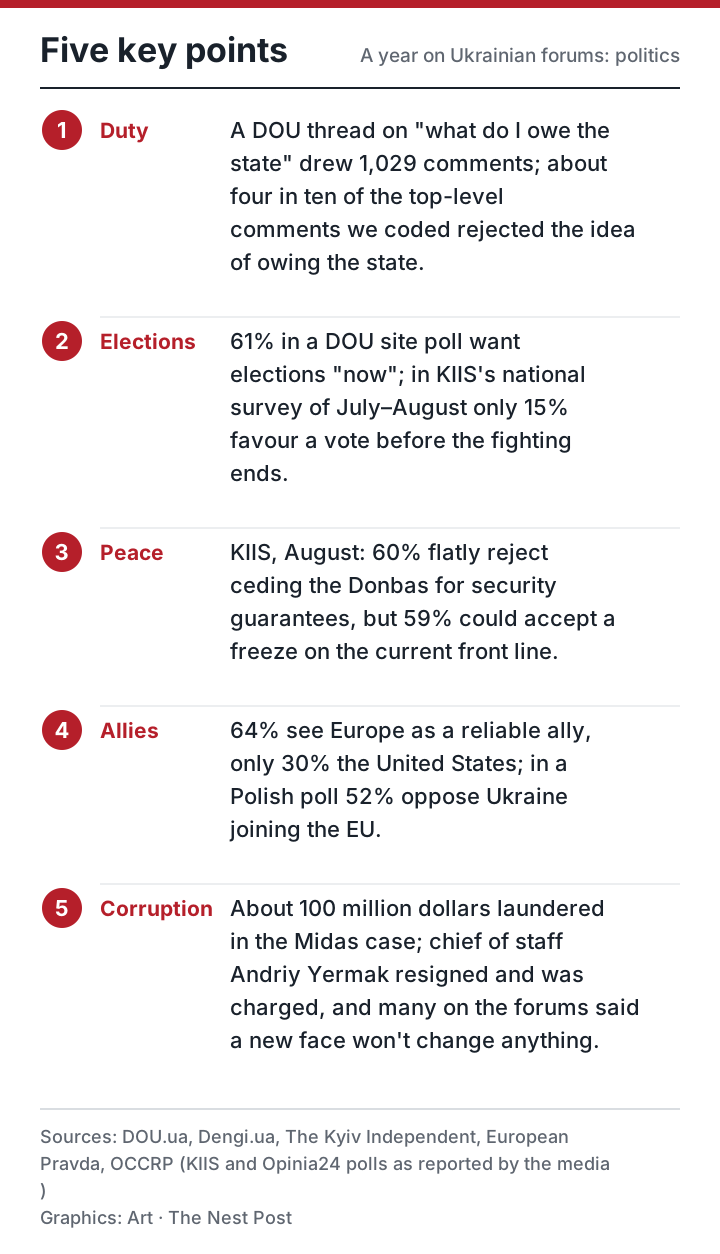
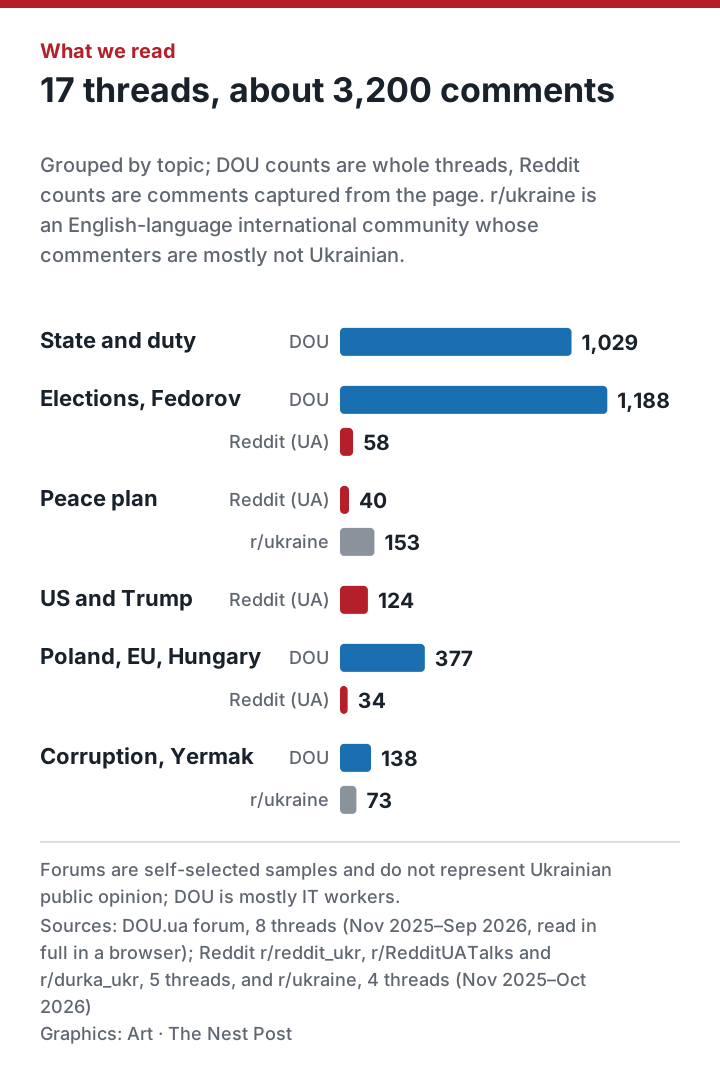
On 11 June 2026, on DOU, the forum of Ukraine's IT community, a user who said he had 20 years in business wrote up his thoughts after an interview. The journalist being interviewed had said that military service "is not a change of profession, it is a duty". The poster took the argument further: "do I want to fight?" is the wrong question; the right one is "do I want to exist inside the structure of this state?", and if the answer is yes, you owe it. Three days later a one-line reply threw the question back: "No, I don't." The thread went on to collect 1,029 comments. In the fifth year of the war, Ukrainians online argue not only about prices and conscription but about the state itself: whether to hold elections in wartime, whether to trade the Donbas for peace, whether the United States can still be trusted, what Poland and the EU want, and why people around the president keep turning up in corruption cases. This is the last part of our three-part series "A year on Ukrainian forums"; the first two looked at daily life and at culture. We read 17 political threads and about 3,200 comments on DOU and Reddit, and set them against national polls: the loudest opinions on the forums are often not the majority's.
In this story
- "What do I owe?": a duty debate that ran for two months
- What happened this year: a corruption case, a peace plan and a sacked minister
- The corruption scandal: "Ali Baba" falls, but the forum says a new face won't change anything
- The Donbas for peace? The forums argue about who asks, and how
- Wartime elections: 61% on a forum poll say "vote now"; 15% nationally
- America, Europe and Poland: the ledger of trust in allies
- How the mainstream media see it, and what the forums add
"What do I owe?": a duty debate that ran for two months
The thread's author said he wrote it after hearing Portnikov's interview at "DOU Day 2026". Vitaly Portnikov is a Ukrainian journalist and long-time columnist for Radio Liberty who won the Shevchenko National Prize in 2023. The poster wrote down two phrases: "military service is not a change of profession but a duty", and "we must preserve the state, and that task is not yet done". From 20 years in business he reasoned that language, law, markets, property and contracts are all kept running by the structure of the state.
Тому неправильне питання: «Чи хочу воювати?». Бо воно нікуди по суті не приведе; а от питання, яке кудись веде: «Чи хочу я існувати всередині цієї конструкції?» — і коли відповідь «так», то ти їй зобов’язан за це.
So the wrong question is "Do I want to fight?", because it really leads nowhere; the question that leads somewhere is "Do I want to exist inside this structure?" — and if the answer is "yes", you owe it for that.
DOU is Ukraine's largest community of IT workers. Nearly six in ten of the thread's comments arrived in its first week. The most common rebuttal was not "I don't love my country" but a separation of "the state" from "us": the state is a concrete bureaucratic machine, staffed by named people who must answer for its failures. One user replied in a single line:
«Чи хочу я існувати всередині цієї конструкції?» Ні, не хочу.
"Do I want to exist inside this structure?" No, I don't.
Держава — це конкретний чиновницький апарат. Кожен в цьому апараті несе відповідальність, в тому числі кримінальну, за злочинну недбалість і перевищення повноважень. Припиняйте оцю дурку. Держава — це НЕ ми!
The state is a concrete bureaucratic apparatus. Everyone in that apparatus bears responsibility, including criminal responsibility, for criminal negligence and abuse of power. Stop this nonsense. The state is NOT us!
Some sided with the poster, but with conditions attached. The day before, another user had written "the state is us", then added that the state exists to protect its citizens, and if it serves only part of the ruling class the consensus falls apart.
Держава — це ми. Вона будується на консенсусі між її громадянами, а тому існує лише для захисту інтересів своїх громадян. Якщо консенсус зникає — зникає і держава.
The state is us. It is built on consensus among its citizens, and so exists only to protect the interests of its citizens. If the consensus disappears, the state disappears too.
Повинен — це коли щось дали в борг, щось матеріальне. А коли боргу немає, то й обов’язку немає :)
You "owe" when something was lent to you, something material. And when there's no debt, there's no duty :)
Those defending duty were few but tireless. One user who called himself an army officer posted 85 comments in the thread and shared recruitment ads. His reply turned the question into one of courage:
Не хочеш — не йди. Сиди далі вдома, вже й так 4 роки сидиш, Bolt поїсти привезе. Але не прикривай страх «логікою» і балачками про те, що нічого не винен.
Don't want to — don't go. Keep sitting at home, you've already sat there 4 years, Bolt will bring you food. But don't cover fear with "logic" and chatter about owing nothing.
The thread's longest reply chain began with a user born in the Soviet Union. School taught him, he wrote, that a man's highest duty is to give his life for the motherland; then the USSR vanished overnight, along with people's savings and jobs. To him, talk of "owing the state" sounded all too familiar. Another user put it more bluntly:
Цікава підміна понятть — інтереси мафіозних кланів подаються як держава. А те що вони тебе не до кінця обобрали — як досягнення, за яке маєш віддати життя.
An interesting sleight of hand: the interests of mafia clans are presented as the state. And the fact that they haven't robbed you completely is presented as an achievement you must give your life for.
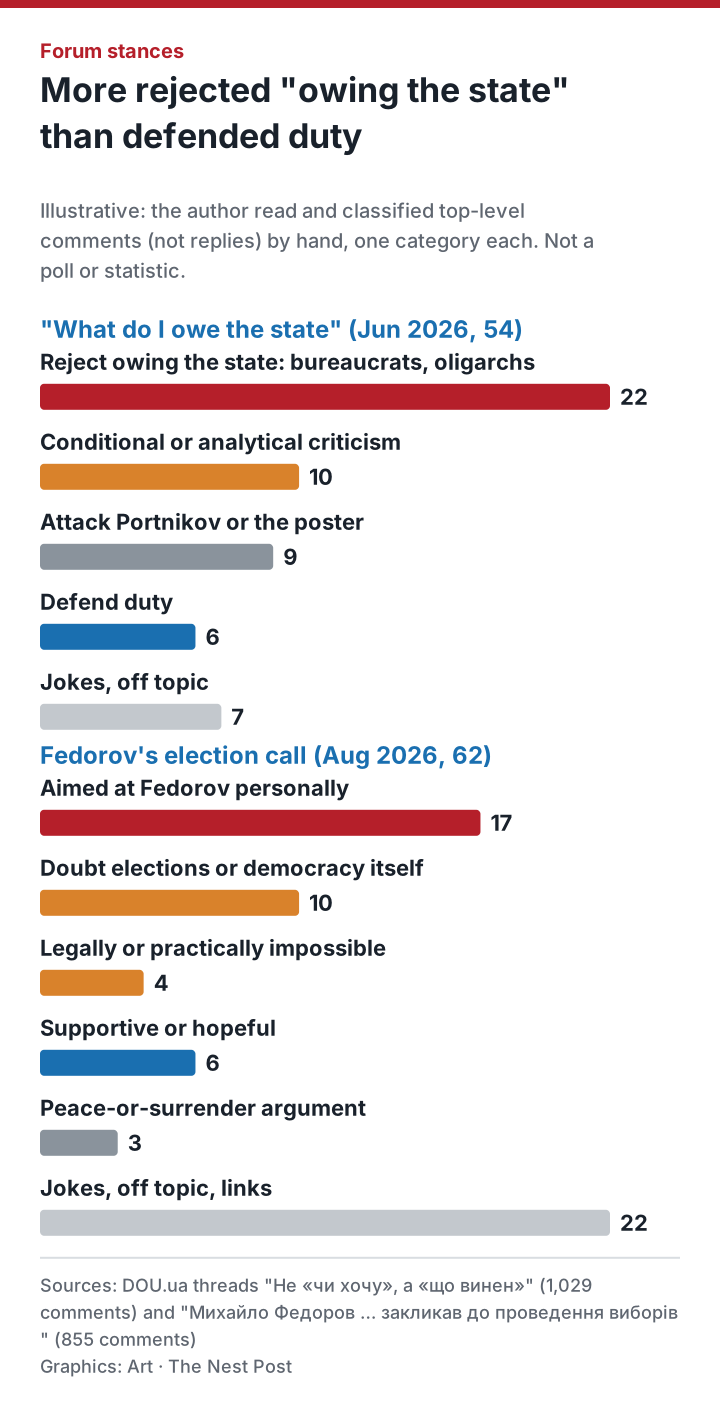
AnalysisWe sorted the thread's 54 top-level comments (excluding replies and one blank post) by hand: 22 (about four in ten) explicitly rejected the idea of owing the state, 6 defended duty, 9 attacked Portnikov or the poster personally, 10 offered conditional or analytical criticism, and the rest were jokes or off topic. Those rejecting the idea mostly did not speak up for Russia; their target was the coercive methods of the recruitment centres, the oligarchs and the privileged. This is a community dominated by IT workers, many of them already abroad, and the proportions describe this sample only.
What happened this year: a corruption case, a peace plan and a sacked minister
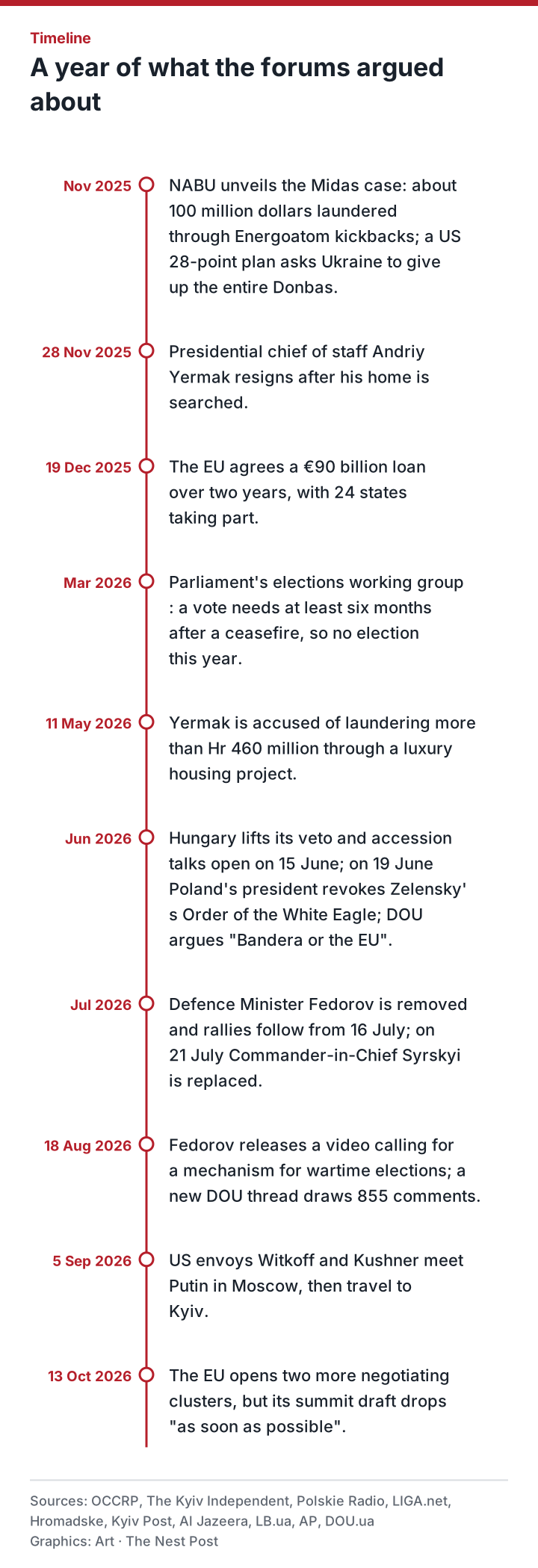
To make sense of these arguments, go back to November 2025. The National Anti-Corruption Bureau (NABU) unveiled an investigation codenamed "Midas": a group of "shadow managers" allegedly demanded kickbacks of 10–15% of contract value from contractors of the state nuclear operator Energoatom and laundered about $100 million. Those named included Timur Mindich, a long-time friend and former business partner of President Zelensky, and Justice Minister Herman Halushchenko, a former energy minister.
In the same month the United States put forward a 28-point peace plan. As summarised by The Kyiv Independent, it required Ukraine to give up the entire Donbas, including cities its troops still held, capped the army at 600,000 and paused NATO membership; Trump gave Kyiv until 27 November. Zelensky said at the time that Ukraine might have to choose between "the loss of dignity" and "the risk of losing a key partner". CBS reported that the plan grew out of talks in October between US envoy Steve Witkoff and Putin adviser Kirill Dmitriev.
On 28 November anti-corruption investigators searched the home of Andriy Yermak, head of the President's Office, and he resigned the same day. MP Yaroslav Zheleznyak said a person codenamed "Ali Baba" in NABU recordings was believed to be Yermak. On 11 May 2026 anti-corruption prosecutors accused him of laundering more than Hr 460 million through a luxury housing project outside Kyiv.
On 19 December EU leaders agreed to lend Ukraine €90 billion for 2026 and 2027, but only 24 states joined the common borrowing; Hungary, Slovakia and the Czech Republic stayed out. The EU Council later made disbursements conditional on the rule of law, including the fight against corruption.
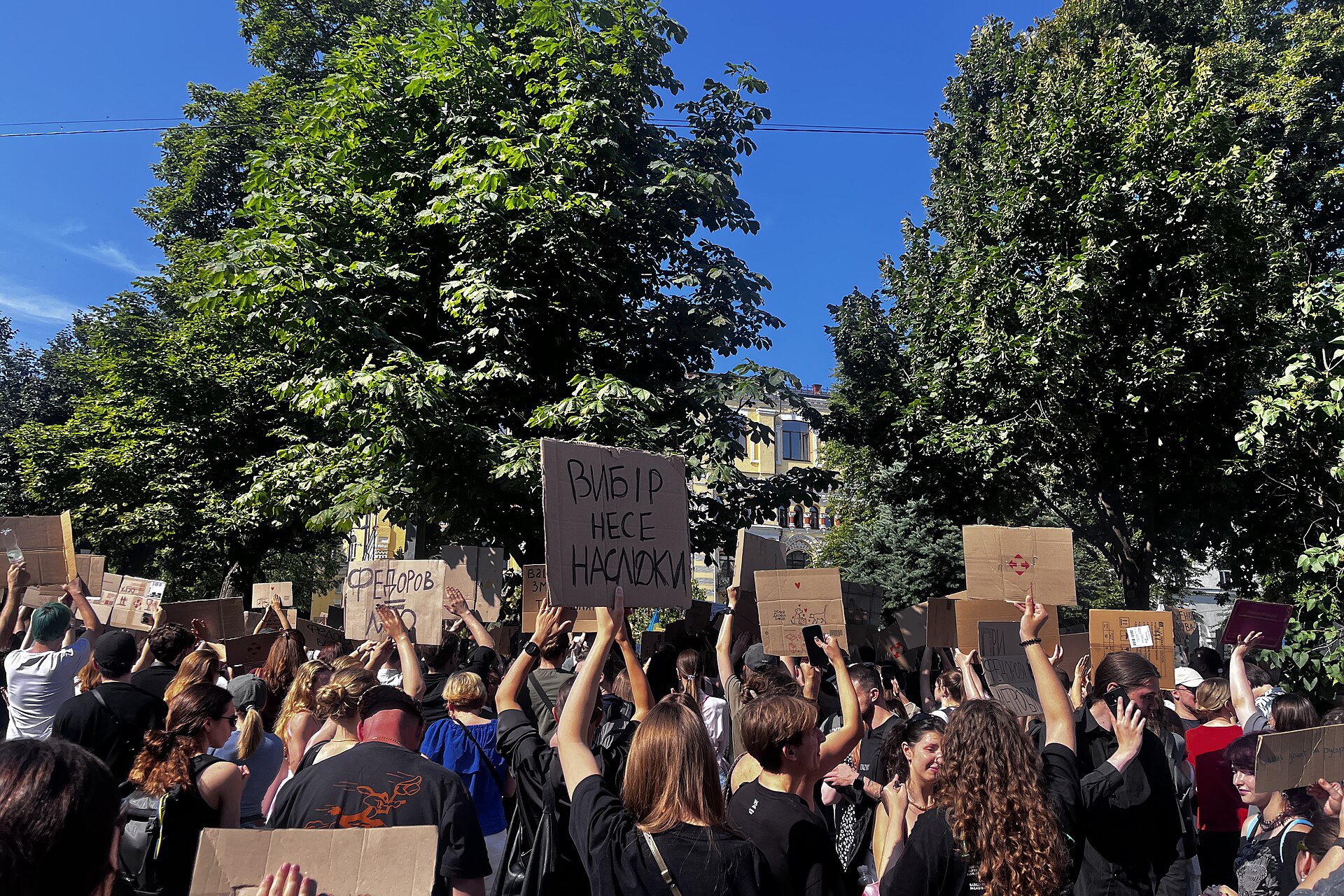
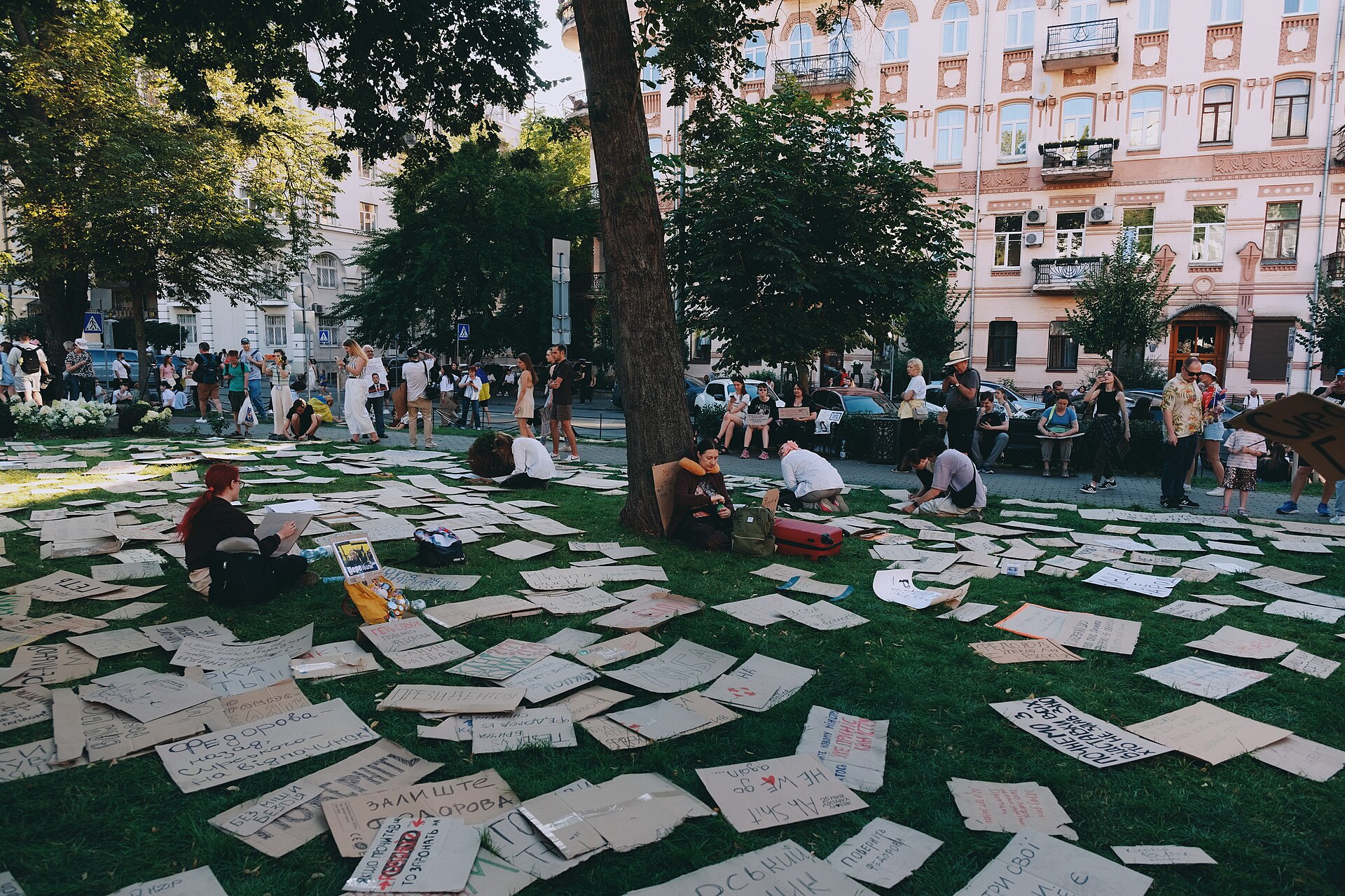
In summer 2026 one political crisis followed another. On 14 July parliament dismissed Yulia Svyrydenko's cabinet, and Mykhailo Fedorov, the former digital transformation minister who had become defence minister only in January, lost his job in the reshuffle; once the news broke, rallies were held in Kyiv and at least ten other cities. The Kyiv Independent reported thousands outside the President's Office on 16 July chanting "Reappoint!". On 21 July Zelensky replaced Commander-in-Chief Oleksandr Syrskyi with Mykhailo Drapatyi; the protesters' two demands had been Fedorov's return and Syrskyi's removal.
On 18 August the president nominated Yevhen Khmara as defence minister. That same day Fedorov released a video saying Ukraine faced a governance crisis, and asked whether, if the war lasts for years, Russia would in effect be given the right to decide when Ukrainians can elect their government again. He called for a legal, safe and realistic mechanism that would let soldiers and Ukrainians abroad vote. Under martial law the constitution does not allow elections; in March parliament's elections working group concluded that at least six months of preparation would be needed after a ceasefire, which effectively ruled out a presidential election in 2026.
Peace talks, meanwhile, stayed stuck on territory. On 5 September US envoys Steve Witkoff and Jared Kushner spent more than three hours with Putin in Moscow before travelling on to Kyiv; Zelensky insisted any deal must include security guarantees and a "dignified post-war peace", while Moscow says territorial concessions are non-negotiable.
The corruption scandal: "Ali Baba" falls, but the forum says a new face won't change anything
After the Midas case broke, a DOU user living in Antalya, Turkey, opened a thread backing activist Mariia Barabash's plan to stand with placards on Kyiv's Independence Square demanding Zelensky's resignation. About a third of the thread's 103 comments came from him, and most replies were not about corruption at all but questioned what right someone abroad had to call people out. Some defended the critics:
В Украине сейчас просто не безопасно высказывать мысли в духе тех что написаны в исходной статье ибо могут прийти в гости.
In Ukraine it is simply not safe now to express thoughts like those in the original post, because they may come to visit.
Замінити Зе підчас війни неможливо, нажаль. Але можна хоча б тиснути на його слуг, щоб вони нарешті відлипли від його доларової цицьки і почали працювати на країну, сформувавши нормальний, професійний, а не політичний і бандитський, уряд.
Replacing Ze during the war is impossible, unfortunately. But we can at least press his servants to finally peel themselves off his dollar teat and start working for the country, forming a normal, professional government rather than a political and gangster one.
On the day of the action the poster announced he would stop writing about Zelensky's resignation "because it provokes the community"; that evening someone reported that only 15 people had turned up. A few days later another DOU thread shared a petition registered by MP Yaroslav Zheleznyak demanding Yermak's dismissal. The first replies were almost all mockery:
Президент дав чітко зрозуміти, що українці не можуть втратити три речі: гідність, свободу і Андрія Єрмака.
The President made it clear that Ukrainians cannot lose three things: dignity, freedom and Andriy Yermak.
On the evening of 28 November someone posted a single line of news in the thread: the president had dismissed Yermak. There was no celebration; the comments that followed asked whether the search was staged, and whether whoever replaced him would be any different.
The same case looked quite different on the English-language r/ukraine, an international community where most commenters are not Ukrainian. In two threads in May and June 2026 about Yermak's laundering charge and the housing project, the dominant tone was that the anti-corruption system works; some even said Ukraine does more than some EU and western countries.
It’s impressive how systematically and diligently Ukraine is now working to end corruption. Even going after top officials.
A year ago Zelinsky's govt tried to neuter the anti-corruption agency. Only massive public outcry stopped it.
The second comment refers to July 2025. OCCRP reported Zheleznyak's account that recordings showed "Ali Baba" trying to undermine the anti-corruption bodies' independence, a plan halted by public protests. Ukrainians called that street movement, in which people held up cardboard signs, the "cardboard protests"; a year later the rallies for Fedorov borrowed the same form.
AnalysisWhere the international community saw the system working, the local IT forum saw the system's disease. The two views are not contradictory: the anti-corruption bodies did reach the president's inner circle, but for people facing conscription and blackouts every day, who comes next matters more than who was caught. This is our inference from the difference in tone between two small samples.
The Donbas for peace? The forums argue about who asks, and how
After the 28-point plan surfaced, a user on the Ukrainian-language r/reddit_ukr asked which points were least acceptable and what to do about them. His own answer was unexpected: after going through the plan point by point he judged that neither the army cap nor the NATO clause was fatal; the real problem was whether Russia, having bypassed the Donetsk defences, would simply attack again a year later. The replies were divided.
Мені найбільш неприйнятним є реабілітація воєнних злочинців. Зло лишається непокараним, ще й навпаки отримає заохочення в вигляді територій
For me the most unacceptable is the rehabilitation of war criminals. Evil remains unpunished and on the contrary gets rewarded with territory
Знову таки, для того, щоб диктувати свої умови - необхідно мати важелі на перемовинах: наступ на фронті, економічна важливість для світової економіки, сильний дипломатичний корпус та десятки інших важливих факторів.
Again, to dictate your terms you need leverage in negotiations: an offensive at the front, economic importance for the world economy, a strong diplomatic corps and dozens of other important factors.
Враховуючи сучасні реалії і корупційні скандали, час братись за переговори.
Considering current realities and corruption scandals, it's time to get down to negotiations.
The last comment links corruption to the talks: if those at the top keep stealing, people at the front cannot hold out. The English-language r/ukraine was almost unanimous; one comment said the plan contained an amnesty clause that, according to friends at the front, would let the government off for its own corruption. The first comment in another thread was a single line:
That's not a Peace Plan that's a Surrender.
National polls paint a finer picture than the forums. A late-2025 survey by the Kyiv International Institute of Sociology (KIIS) found 74% opposed a plan that included withdrawing from the Donbas and capping the army without reliable security guarantees, while 69% backed freezing the war with security guarantees provided Ukraine did not have to recognise occupied land as Russian. Opposition to handing over all of Donetsk oblast in exchange for guarantees fell from 62% in early March 2026 to 57% at the end of April, then rose again to 60% in late July and early August; in the same survey 59% would accept a freeze along the current front line and 31% were firmly opposed.
In August, in a DOU thread about elections, someone cited polls like these, saying the government "acts as if the majority wants to fight". Another user replied:
Бо питають неправильно: питати треба чи готові особисто ви піти захищати рештки Донбасу?І тоді відразу виявиться що охочих воювати за Донбас далеко не 60%.
Because they ask the wrong question: they should ask whether you personally are ready to go and defend the rest of Donbas. And then it will immediately turn out that those willing to fight for Donbas are far fewer than 60%.
AnalysisThe rebuttal points to something polls struggle with: "opposing concessions" and "being willing to go to the front yourself" are different questions. But it also shows where forum positions come from. DOU users are largely men of conscription age, many already abroad, and their views on peace talks cannot be separated from their fear of the draft. KIIS's wartime phone polls exclude citizens who have left the country, so this group is loud on the forums and almost absent from the polls.
Wartime elections: 61% on a forum poll say "vote now"; 15% nationally
The day after Fedorov's removal, DOU's editors opened a thread asking readers to share photos of the rallies. Of its 220 comments, few actually spoke up for him; more aimed at the president and the whole mobilisation system, and some suspected the rallies had been paid for.
Невже не зрозуміло що проблема не у Федорові?
Isn't it clear that the problem isn't Fedorov?
Я ж правильно розумію шо ті хто вийшли на акцію — підписали нові контракти від федорова та МО і хочуть підтримати міністра за його ефективність? :D
So do I understand correctly that those who came out to the rally signed the new contracts from Fedorov and the MoD and want to support the minister for his efficiency? :D
какая мне разница ?) придет Клименко будут вытягивать из квартир. для меня ничего не поменяется
What difference does it make to me?) Klymenko comes, they'll drag people out of flats. Nothing will change for me.
Ihor Klymenko was the interior minister then proposed as defence minister; "dragging people out of flats" refers to forced conscription. On Ukrainian-language Reddit, a post on 18 August called people to rally outside parliament the next day under the line "the people demand one thing". The argument underneath turned on who "the people" are:
Дуже невелика кількість громадян не співпадає з заявою "народ вимагає".
A very small number of citizens does not match the claim "the people demand".
Те, що суспільство, напевно, вперше в історії України добровільно через свою громадянську позицію й обурення з відверто поганих рішень влади вийшло на підтримку конкретного політика говорить само по собі.
The fact that society, probably for the first time in Ukraine's history, voluntarily, out of civic conviction and outrage at openly bad government decisions, came out in support of a specific politician speaks for itself.
Вірити в те, що одна людина щось змінить - наївно. Проблема не у прізвищах, а у системі.
Believing that one person will change something is naive. The problem isn't names but the system.
As soon as Fedorov's video appeared that evening, DOU's defence-tech section opened a new thread; 490 comments poured in the next day alone, and the thread reached 855. We sorted its 62 top-level comments: the largest group was not about elections at all but about Fedorov himself (17), along the lines of "he remembered elections once he was fired" and "he's a western torpedo". Fourteen said elections were impossible or pointless; only 6 were supportive or hopeful.
Проведення виборів буде абсолютним чудом. Але навіть сам факт, що хтось наважився про це заговорити, породжує надію, вперше за довгий час.
Holding elections would be an absolute miracle. But even the mere fact that someone dared to talk about it gives rise to hope, for the first time in a long while.
Вибори по закону не можливі. Крапка. Най назве краще і покаже корупційні схеми.
Elections are not possible under the law. Full stop. Better he names names and exposes the corruption schemes.
Очевидно, що вибори потрібні лише для обрання українського Петена, котрий і підпише мир (капітуляцію).
Obviously, elections are needed only to elect a Ukrainian Pétain who will sign the peace (capitulation).
An older thread opened in July, "Is it time for elections?", came back to life with the video. It carried a site poll: of 437 votes, 61% chose "yes, elections are needed now", 17% "needed, but only after the fighting ends" and 14% "elections cannot be held in wartime". The fix most often proposed in the comments was voting through Diia, the state-services app.
Хлопці чатяться з окопу і зарплату дружині на Приват кидають з бліндажів. Голосування у Дії зробити більш, ніж реалістично.
The guys chat from the trenches and send their salary to their wives via Privat from dugouts. Voting in Diia is more than realistic.
Під час війни провести вибори неможливо, бо мійльон військових проголосувати не зможе. Ну і багато інших причин також. Ото й уся дискусія.
It's impossible to hold elections during war because a million soldiers won't be able to vote. And many other reasons too. That's the whole discussion.
Це не дискусія, це відмазка.
That's not a discussion, it's an excuse.
National polling points almost the other way. A KIIS survey from 20 July to 3 August, between Fedorov's removal and his election call, found only 15% saying elections should be held before the fighting ends, 23% after a ceasefire with security guarantees, and 57% only after a final peace agreement and a complete end to the war; trust in Zelensky slipped from 58% in April to 55%. In a survey published in early October, 71% opposed a presidential election in wartime and 53% said Zelensky should not run again; The Kyiv Independent noted that the public did not respond favourably to Fedorov's call.
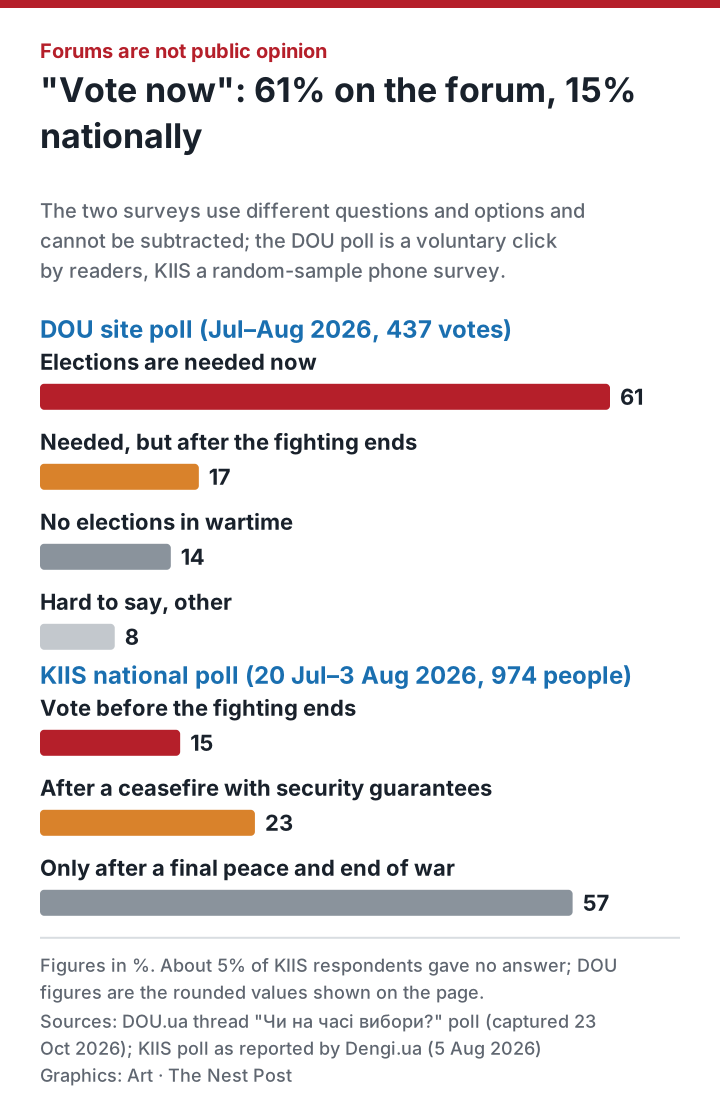
AnalysisThe gap between 61% and 15% is not only about IT workers being keener on a change of government. Any reader can click DOU's poll, and its options are not mutually exclusive, as one commenter complained ("the first three options don't contradict each other"); KIIS runs random-sample phone surveys that exclude people who have left. More importantly, those on the forums who most want elections are often those who least trust the current government. KIIS's own breakdown shows that even among people who do not trust Zelensky at all, only 44% back elections before the fighting ends.
America, Europe and Poland: the ledger of trust in allies
In October 2026 a user on r/reddit_ukr reposted a meme from a year earlier and asked: "A year on, are there still Trump fans alive in Ukraine?" Among more than 60 comments we did not read a single one openly defending Trump. One said he was not the scary part:
Страшно не те, що він такий тупий, страшно те, що його свідомо обрала більшість.
What's scary is not that he's so stupid, what's scary is that the majority consciously elected him.
До виборів 2024 були підстави вважати, що він може бути нашим слоном, оскільки його попередній термін президентства був вигідний для України, США вперше передавали якусь летальну зброю, проводилися спільні військові навчання, був тиск на Рашку в Сирії.
Before the 2024 election there were reasons to think he might be our elephant, since his previous term was beneficial for Ukraine: the US for the first time handed over some lethal weapons, joint military exercises were held, there was pressure on Rashka in Syria.
The elephant is the symbol of America's Republican Party. In another thread earlier in the year, about Trump's designs on Greenland, one user said America was no longer giving Ukraine aid but selling weapons; another just wanted the war to end:
На скільки пам'ятаю, то президент США не Байден і американці не надають нам допомоги. Вони продають зброю, із завищеними цінами, з можливістю нею користуватись.
As far as I remember, the US president isn't Biden and the Americans aren't giving us aid. They sell weapons, at inflated prices, with permission to use them.
Похуй. Війна головне щоб закінчилася і було світло
Fuck it. The main thing is that the war ends and there's electricity
The polls show the same disappointment with America, though less extreme. In a KIIS survey at the end of 2025, 74% said Trump's presidency was bad for Ukraine and 14% good. A survey from May to June 2026 found 56% thought the United States had grown tired of the war and was pressing Ukraine to make concessions to Russia, and only 30% still saw it as a reliable ally; the share seeing Europe as a reliable ally rose from 58% in January to 64%.
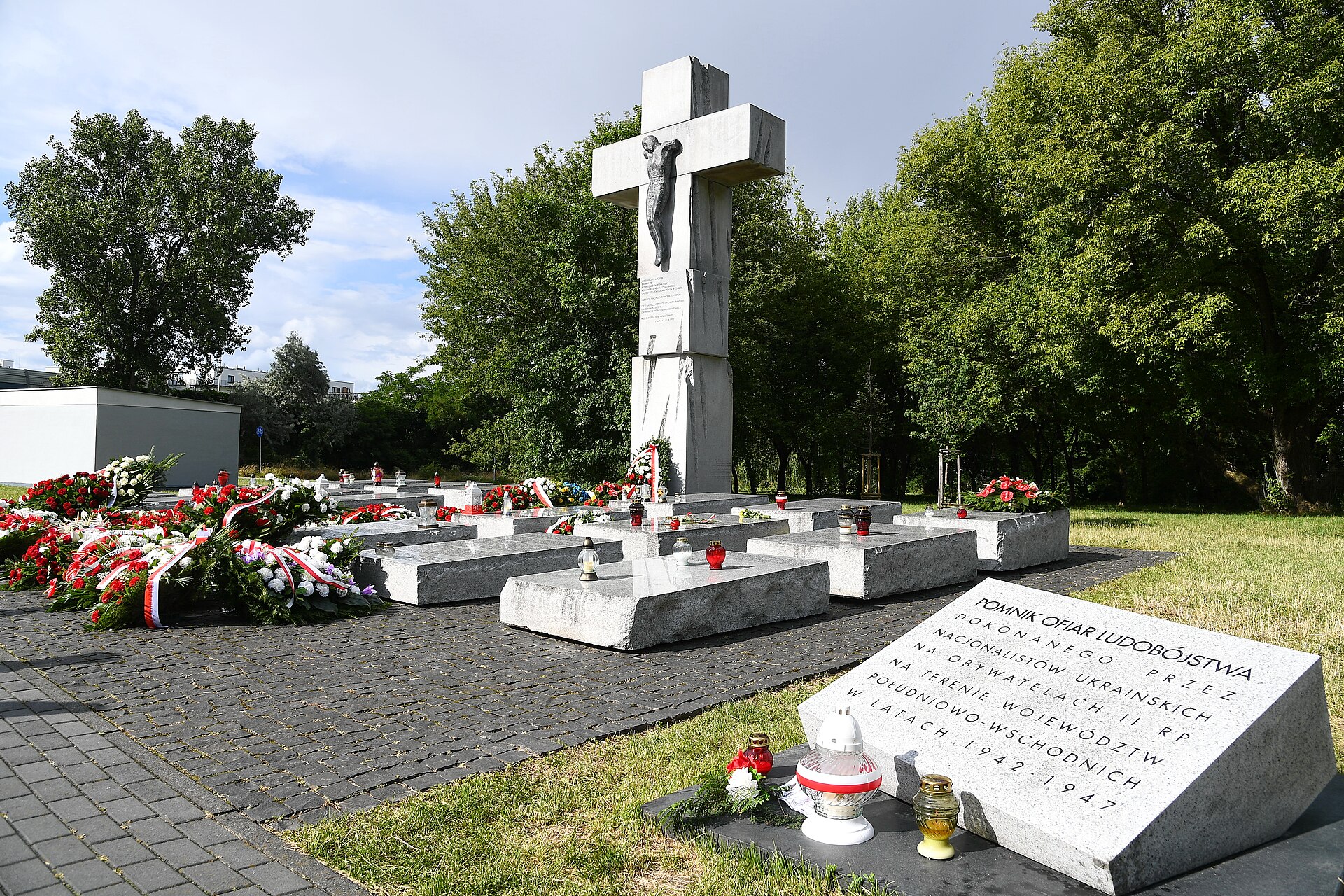
"Europe", though, is not a single bloc. In late May Zelensky gave a military unit the honorary title "Heroes of the Ukrainian Insurgent Army (UPA)". In Ukraine the UPA is seen as part of the independence struggle; in Poland it is tied to the massacres of 1943–45 in Volhynia and Eastern Galicia, in which up to 100,000 Poles were killed. On 19 June Polish President Karol Nawrocki announced he was revoking Zelensky's Order of the White Eagle; Ukraine's foreign minister, Andrii Sybiha, said he would return the Polish award he had received in 2022.
On 30 June Ukrainian media widely reported that Poland's deputy prime minister and defence minister, Władysław Kosiniak-Kamysz, had said in a TV interview that "with Bandera, Ukraine will not join the EU". Notes from Poland, an English-language Polish outlet, later checked: the words were actually spoken by the interviewer, the minister did not endorse them, and the error came from the broadcaster's own written report. In late July, however, he did say Ukraine "will not join the European Union with Bandera on its banner".
The DOU thread built on that line was already in full flow before the fact-check, collecting 363 comments, many of which soon drifted into pensions and the EU market. Among the comments we read that answered "Bandera or the EU" directly, few chose to give up Bandera; more turned their anger on Poland.
«Із Бандерою Україна не вступить до Європейського Союзу». А навіщо нам ЄС, якщо там не буде Бандери?)
"With Bandera Ukraine will not join the European Union." And why do we need the EU if there's no Bandera there?)
В Польщі скоро вибори. Все ці — піна. Після виборів вона спаде.
Poland has elections soon. All this is foam. After the elections it will settle.
Потрібно забути про пана Бандеру до закінчення війни, це легко зробити, бо 99.999% людей не знають хто це. Проблема в тому, що дурнувата влада не дає це зробити.
We need to forget about Mr Bandera until the end of the war; that's easy, because 99.999% of people don't know who he is. The problem is that the stupid authorities won't let us.
Мені цікаво як він виправдає єврейські погроми зчинені окремими членами ОУН(б) в 1941 у Львові ?
I wonder how he will justify the Jewish pogroms carried out by some members of the OUN(b) in Lviv in 1941?
On the meme-oriented r/durka_ukr, in a thread titled only with a Polish flag and a clown emoji, Ukrainian-language commenters listed Polish units named after Piłsudski and the Home Army, while English-language commenters retorted that "Germany apologised and doesn't celebrate Nazis". One reminded others that at his first meeting with Zelensky, Nawrocki gave him a book about Volhynia.
When you stop tolerating Piłsudski and the Home Army, then we’ll talk
The resentment runs both ways. In a mid-July survey by the Polish pollster Opinia24, 52% of Poles opposed Ukraine joining the EU and 33% supported it; 55% approved of Nawrocki revoking the order; 44% said military aid to Ukraine should be suspended over the UPA issue, against 41% who said it should continue; and 36% said their attitude to Ukrainians had worsened. Kyrylo Budanov, head of Ukraine's Presidential Office, said tensions between the two countries had not yet peaked.
Another hurdle on the road to the EU was Hungary. In February a DOU user wrote a long post asking "why can Hungary afford to be neutral?", and the 14 replies almost all disagreed, drawing on the Second World War:
Нейтралітету не існує. Коли є хтось, хто хоче і може захопити країну він її захопить.
Neutrality doesn't exist. When there is someone who wants to and can seize a country, he will seize it.
Viktor Orbán, in power for 16 years, then lost Hungary's parliamentary election. At a meeting of EU ambassadors on 3 June the new prime minister, Péter Magyar, lifted a 17-month veto, on condition that Ukraine expand the linguistic, educational and political rights of its Hungarian minority. Ukraine opened the first negotiating cluster on 15 June and the sixth on 14 July, and two more on 13 October; but in October the EU removed "as soon as possible" from its draft summit conclusions on opening the remaining clusters.
How the mainstream media see it, and what the forums add
International media tend to read Ukrainian politics through the lens of Zelensky's power. The day after Fedorov's removal Al Jazeera asked whether Zelensky had created a rival for himself, quoting analysts who said the rallies showed his ratings were slipping. Investigative outlets such as OCCRP wrote up the Midas case as a victory for the anti-corruption agencies, stressing that the probe had reached the president's circle.
Ukrainian media more often focus on figures and procedure. The Kyiv Independent and European Pravda report KIIS polls in full almost every time, including sampling and wording; in December 2025 KIIS's executive director, Anton Hrushetskyi, said an absolute majority of Ukrainians did not demand elections before the end of hostilities, and that outside insistence on elections was seen as an attempt to weaken the country.
AnalysisWhat the forums add is another dimension: how a group of well-educated, relatively well-paid people, many of whom have already left, bargain with the state. They are not necessarily more pro-Russian or more anti-war; what they argue about is whether the state has the right to make demands of them, and what those making the demands have done themselves. These voices are small in the national polls, yet they are the people Ukraine will most need to keep for post-war reconstruction. This is our inference; the forum sample cannot show how many such people there are.
AnalysisThe forums' own biases matter too. Comments in DOU's political threads are concentrated in a few accounts: the most active posted more than 300 times across four threads, mostly in an ironic register; comments using letters unique to Russian made up more than a tenth of the Fedorov election thread, and accusing one another of being "bots", "draft dodgers" or "pro-Russian" is routine. These patterns may come from real users or from people deliberately stirring things up; we cannot tell.
Back to the June thread that asked "what do I owe the state?". It had all but died by the end of June when, in the early hours of 17 August, someone came back to leave a final line: "Such a mighty reinforcement you've got there." No one replied. In the first two parts we wrote about how Ukrainians online tally the costs of daily life and how they hold on to their language and culture; this part's ledger records how much trust is left between people and the state.
Subscribe to the newsletter from The Nest Post
One email each time an in-depth story is published, with the key points and any corrections. No advertising; unsubscribe at any time.