Justice and technology / Analysis
AI and judgement · Taiwan’s courts
Judges get Copilot, defendants write appeals with AI: how AI entered Taiwan’s courts through two doors

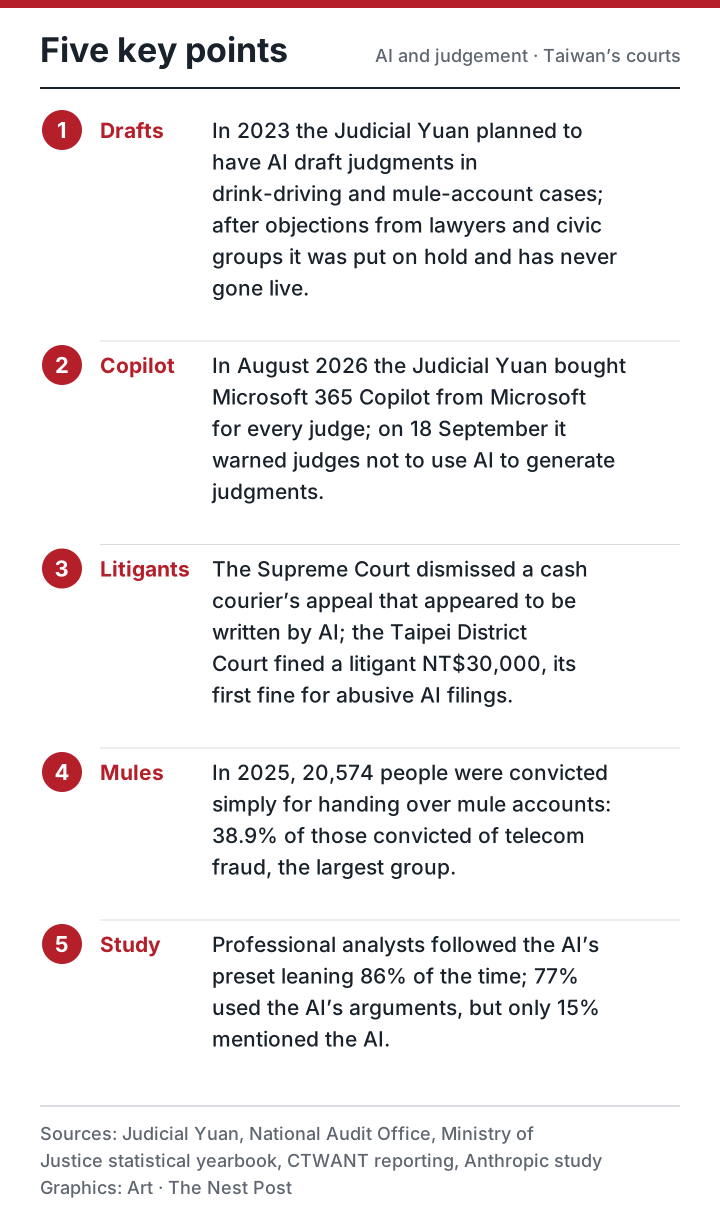
In September the Seventh Criminal Division of Taiwan’s Supreme Court received the grounds of an appeal. The appellant, surnamed Li, was a cash courier for a fraud ring who had withdrawn NT$120,000 that a victim had transferred, from a convenience-store cash machine in Tainan; at first and second instance he was sentenced to one year and two months. In its judgment the panel noted that the appeal appeared to have been written with a generative AI tool. The Supreme Court did not dismiss it for that reason. Instead it set out a principle in the judgment: using AI to write an appeal is not unlawful, but AI “may not be able to write a lawful ground for a third-instance appeal”. The appeal was still dismissed, and the verdict became final. The same month the Judicial Yuan sent a letter to every court in Taiwan, this time addressed to judges: AI may serve only as an aid to adjudication; it may not be used to generate judgments, and AI output may not be adopted “without substantive review”, or judges may be in breach of the Judges Act. Before that, on 31 August, the Judicial Yuan had issued a letter announcing that it had bought Microsoft 365 Copilot from Microsoft for every judge in Taiwan. Three years ago the Judicial Yuan wanted AI to write draft judgments in drink-driving and mule-account cases, and halted the plan after objections from lawyers and civic groups. That system has never gone live. But AI has entered Taiwan’s courts anyway, and through two doors at once: one on the judge’s desk, the other in the hands of litigants who cannot afford a lawyer. We read three years of Judicial Yuan press releases, National Audit Office reports, the Judicial Yuan’s written reports to the Legislative Yuan, transcripts of legislators’ questioning, the Ministry of Justice’s statistical yearbook, press reports and discussions of “AI judges” on PTT, and compared them with an experiment published by the AI company Anthropic on 27 October. The experiment found that professional analysts went along with a leaning the AI had been set in advance 86% of the time. The Judicial Yuan requires judges to carry out a “substantive review” of AI output; the question is whether the reviewer’s judgement is still their own.
In this story
- The “AI draft judgments” halted three years ago have still not gone live
- 2026: AI comes in through another door, with Copilot and a warning letter
- Is “substantive review” possible? One experiment’s answer
- On the other side of the courtroom: people who cannot afford a lawyer hand their cases to AI
- Mule-account defendants: the group that most needs human judgement, and the most likely to be processed “at one click”
- Online, people want “AI judges” because they do not trust human ones
- How others regulate it: England makes judges personally responsible; in America, judges were caught out by their staff’s AI
- Whose name is signed on the last line of the judgment
The “AI draft judgments” halted three years ago have still not gone live
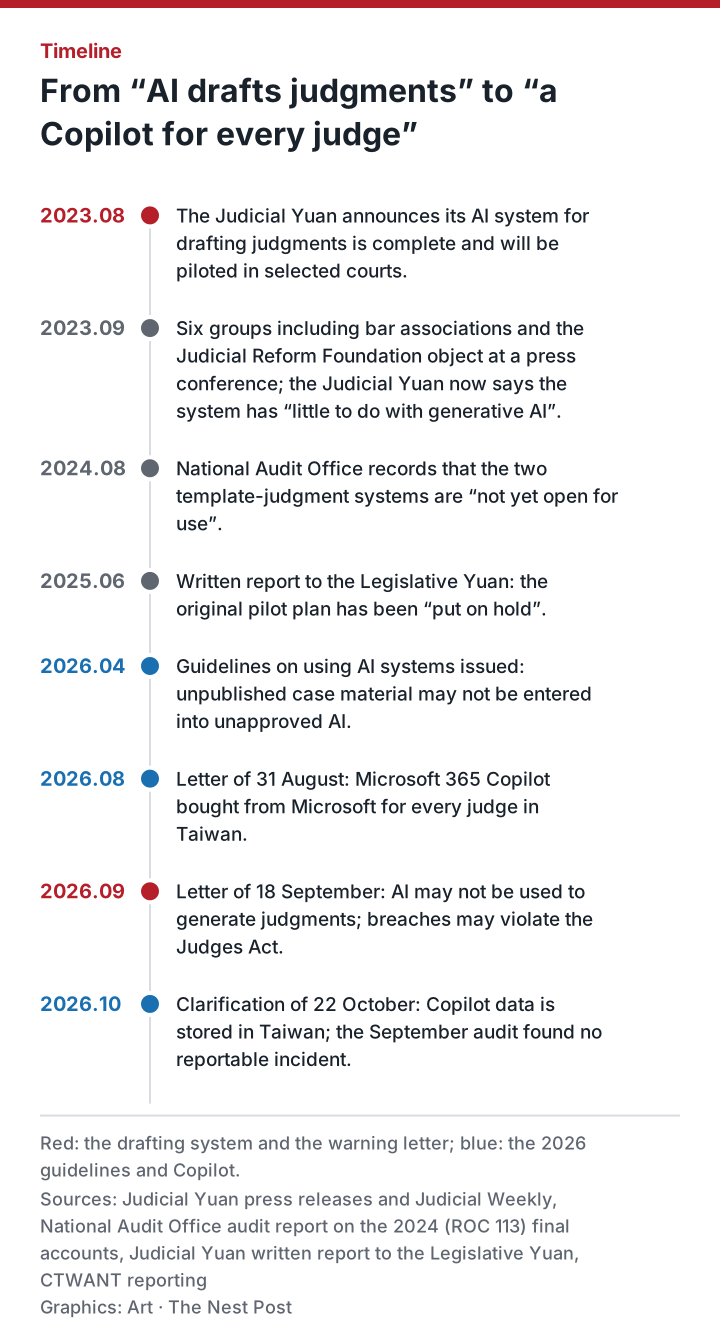
The story begins in 2023. On 27 August that year the Judicial Yuan said in a press release that it had completed AI systems for drafting judgments in two kinds of offence, “unsafe driving” (mainly drink-driving) and “aiding fraud”, and would select a few courts to pilot them. A system for drug offences had already been put out to tender, with civil compensation for traffic accidents and consumer-debt cases to follow. The Central News Agency reported that day that the system had been developed by Chunghwa Telecom and could be fully launched as early as the end of September.
These two kinds of case were chosen because they were “simple and numerous”. Drink-driving needs no explanation; “aiding fraud” cases mostly involve people who handed their bank accounts to fraud rings as money-mule accounts, one of the largest categories of case in Taiwan’s courts every year.
A month later six groups, including the Taiwan Bar Association, the Taipei Bar Association and the Judicial Reform Foundation, held a press conference at the Legislative Yuan. The foundation’s questions were specific: if the training data consisted only of indictments and judgments, how could the system “analyse evidence”? How would the outside contractor build its database? Most fundamentally, in a mule-account case, whether the defendant handed over an account “intentionally” is not something a data model can judge.
且據美國普渡大學(Purdue University)發表的研究發現,在AI系統的正確率在未達5成的情況下,會有高達4成的使用者無法察覺系統的錯誤。
Citing a study from Purdue University in the United States, the foundation said that even when an AI system was less than 50% accurate, as many as 40% of users failed to notice its errors.
In questioning, Legislator Lin Shu-fen (林淑芬) asked the Judicial Yuan to make clear which parts of a judgment drew on AI. The answer from Wu San-lung (吳三龍), then the Judicial Yuan’s secretary-general, is the template for everything the Judicial Yuan says today:
我如果是當事人,我會希望法官應該要告訴我們,這份判決書哪個地方是參考 AI 的
If I were a party to a case, I would want the judge to tell us which parts of the judgment drew on AI.
現階段每個字都是法官斟酌的,不可能由 AI 去生成,都是法官斟酌的。
At this stage every word is weighed by the judge. It cannot be generated by AI.
On 27 September the Judicial Yuan responded in a press release, in noticeably different terms: the parts quoting the facts of the offence from the indictment “did not use any generative AI technology”, the system as a whole had “little to do with generative AI technology”, and no launch date had been set. The press release a month earlier had said it was built by fine-tuning the TMT5 language model.
After that, nothing more was heard of the system. In its audit report on the 2024 (ROC 113) final accounts, the National Audit Office recorded that as of the end of August 2024 the two template-judgment systems were “not yet open for use”. Six other Judicial Yuan AI systems had gone live, but guidelines on managing their risks were still being drafted, which the audit office said “may not help ensure the safe use of artificial intelligence”. In June 2025, in a written report sent to the Legislative Yuan under a budget resolution, the Judicial Yuan acknowledged that it had “put the original pilot plan on hold”. In May this year the China Times reported that the system had not been implemented.
2026: AI comes in through another door, with Copilot and a warning letter
While the drafting system was stalled, commercial AI tools had already entered the courts. On Judicial Day in January, Hsieh Ming-yan (謝銘洋), the Judicial Yuan’s acting president, said it had set up a “technology and justice task force” to use AI to help with searching, organising and analysing literature and precedent. On 22 April the Judicial Yuan issued its Reference Guidelines for the Use of Artificial Intelligence Systems by the Judicial Yuan and Its Subordinate Agencies: unpublished indictments, records of proceedings, draft judgments and similar material may not be entered into unapproved AI systems, and weighing evidence, finding facts, applying the law and sentencing must still be done by judges themselves.
Courts around the country soon began running courses. In May the Taichung District Court brought in a presiding judge and a judicial assistant from the Nantou District Court to teach 120 judicial assistants how to build workspaces with ChatGPT, Gemini and NotebookLM. A talk at the Shilin District Court demonstrated using AI to quickly generate suggested mediation strategies and mediation records. The Kaohsiung Juvenile and Family Court invited a judge of the Supreme Administrative Court to introduce tools such as ChatGPT and Copilot, who also demonstrated a local language model deployed offline. Every speaker stressed the same point: AI is an aid, and the final judgement belongs to people.
A CTWANT series in October revealed that on 31 August Kao Chin-chih (高金枝), the Judicial Yuan’s secretary-general, had issued a letter announcing that Microsoft 365 Copilot had been bought from Microsoft and would be given to every judge in Taiwan; only code tables for anonymous witnesses, national-security cases and trade-secret cases were barred from being uploaded. The reports also said that some judges were “heavy users” of AI as a reference when writing judgments, which had long been an open secret in legal circles. On 18 September the Judicial Yuan sent out its warning letter.
人工智慧系統僅得作為審判輔助工具,不得用於生成裁判書,亦不得就人工智慧產出之內容,未經實質審查即逕予採用。
AI may only serve as an aid to adjudication. It may not be used to generate judgments, and content produced by AI may not be adopted without substantive review.
On 22 October the Judicial Yuan issued a clarification, saying Copilot data was stored in Taiwan, external connections were blocked and existing access permissions applied, and that an audit in September found no information-security incidents requiring a report. It said it “continues to remind judges to check AI output carefully and not to adopt it without substantive judgement”. The Judicial Yuan has not disclosed how much it paid or how many licences it bought, nor explained how judges actually use the tool.
Is “substantive review” possible? One experiment’s answer
The Judicial Yuan’s rules rest on one premise: AI can draft, organise and suggest, and as long as a person reviews the result at the end, the judgement is still that person’s. An experiment published by Anthropic on 27 October tested exactly that premise.
The researchers asked 50 professional analysts with experience in causal inference to complete a statistical analysis using an AI agent, making four judgement calls along the way in which both options were reasonable. What the analysts did not know was that each one’s AI had been given a preference by a coin toss. The analysts followed the AI’s leaning 86% of the time; if the AI had had no influence, the figure should have been about 50%. Of those who had already stated their own preference, 60% changed their minds when the AI disagreed, against only 6% when it agreed.
More worth the courts’ attention is how they explained themselves afterwards. 77% of the analysts justified their choices with the AI’s arguments, sometimes almost word for word, but only 15% mentioned that the arguments came from the AI. This, the researchers wrote, means human review is no longer an independent check.
a human reviewer is only an independent check if their judgment is their own.
AnalysisThe study has its limits. The AI’s leanings were deliberately strengthened by the researchers; only one task and one profession were tested; and the authors work for an AI company. Analysts using AI also made far fewer serious errors than those who did not. But the mechanism the study reveals closely resembles the situation in a courtroom: the judgement is made by a person and the document is signed by a person, yet the arguments may come from AI.
AnalysisPut that mechanism back in a court. A judge or judicial assistant asks Copilot to organise the case file, summarise both parties’ arguments and search for similar judgments; the AI lays out the “key points” first, and may already have reached conclusions on the issues in dispute. The judge still reviews every word, but the review starts from a different place. The Judicial Yuan’s guidelines require judges to carry out “substantive review”, but do not require them to disclose which passages drew on AI, and the parties have no way of knowing.
On the other side of the courtroom: people who cannot afford a lawyer hand their cases to AI
The other door is on the litigants’ side. The principle the Supreme Court set out in the case of Li, the cash courier, is the first time a Taiwanese court has addressed AI-written filings head-on in a judgment. According to CTWANT, the Seventh Criminal Division put it bluntly: the court has no duty to correct a litigant’s AI errors, including fabricated or wrongly cited facts, legal sources and rulings.
生成式AI可以生成文字,但未必寫得出一個合法的第三審上訴理由;可以協助撰稿,但不能取代當事人承擔訴訟行為。
Generative AI can generate text, but it may not be able to write a lawful ground for a third-instance appeal. It can help draft, but it cannot take the place of the party in bearing responsibility for their acts in litigation.
The Taipei District Court, meanwhile, issued the first fine for abusive AI filings. A bus driver surnamed Hsieh said his mobile number had been hijacked by a fraud ring, so that he was treated as a fraud suspect and had to take leave to be questioned at a police station. After losing a claim for compensation against his telecom company, he pasted his conversations with Copilot into his filings and applied for a retrial again and again. The Fourth Civil Division first dismissed his application, saying that doing this was “not in itself impermissible”, but that the prompts and the context of the conversation would be needed to assess it. He kept using AI to write his filings, and the Second Civil Division found that he was maliciously wasting judicial resources and fined him NT$30,000.
In July a judge at the Taoyuan District Court began a judgment dismissing a dispute over the land of an ancestral house with a section headed “first of all”. The plaintiff had paid more than NT$90,000 in court fees and submitted hundreds of pages of filings; the judge advised him to find a “living, flesh-and-blood, licensed lawyer”, and went on:
不要問AI,不要用AI寫上訴狀,更不要以為人家看不出是AI寫的。
Don’t ask AI, don’t use AI to write your appeal, and above all don’t think people can’t tell it was written by AI.
An observation by lawyer Wang Chih-te (王至德) points to the imbalance: lawyers save time with AI because they have the expertise to check what it produces; ordinary people do not.
沒有法律專業、沒有實務經驗,面對AI提供的建議或是書狀內容都沒有審閱的能力,所以最後只能相信AI
People with no legal training and no practical experience have no ability to review the advice or filings AI gives them, so in the end all they can do is trust the AI.
On PTT, users were divided over the Taoyuan judge’s judgment. Some thought the judge was right to scold; others asked whether the judgment itself might have been written with AI’s help.
說不定判決書也是AI幫忙寫
Maybe the judgment was written with AI’s help too.
AnalysisThe two doors lead to the same question. When judges use AI there are guidelines, warnings and possible discipline, but no duty of disclosure; when litigants use AI, they bear the consequences of its mistakes. The judicial guidance in England and Wales is more explicit: judges need not explain how a judgment was prepared, but when a litigant appears to have used AI to write a filing, the judge may ask about it and remind them that they are responsible for its content.
Mule-account defendants: the group that most needs human judgement, and the most likely to be processed “at one click”
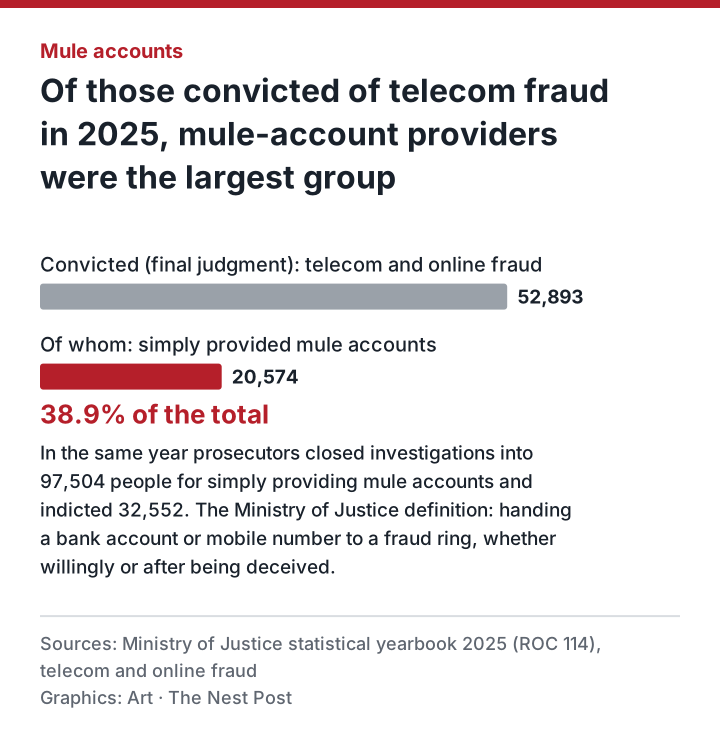
Go back to the kind of case the Judicial Yuan first wanted to hand to AI in 2023. According to the Ministry of Justice’s statistical yearbook, among telecom and online fraud cases closed by prosecutors in 2025, 97,504 people had “simply provided mule accounts”, and 32,552 were indicted. Of the 52,893 telecom-fraud defendants convicted by final judgment, 20,574, or 38.9%, had simply provided mule accounts: the largest group.
The Ministry of Justice definition says that handing an account or mobile number to a fraud ring counts “whether it was provided willingly or after being deceived”. That was exactly what worried the Judicial Reform Foundation: two people may hand over an account in the same way, but whether one was tricked by a loan scam or knowingly took money decides guilt or innocence. On PTT’s Lawyer board, posts from relatives looking for a lawyer for a defendant are common.
我表哥被詐欺的找上,一時愚昧被對方話術所騙,就提供了自己的帳戶。
My cousin was approached by a fraud ring, was fooled by their pitch in a moment of foolishness, and handed over his own account.
家人因貸款被詐騙而成為人頭戶
A family member was scammed over a loan and became a mule account holder.
花律師費,不如省下來坐牢
Rather than spend money on a lawyer, save it and go to prison.
AnalysisThese defendants are numerous and their cases look alike, which makes them the easiest to treat as cases that can be handled in a standard way; they are also the people least likely to afford a lawyer and most likely to turn to AI. The bus driver’s story carries a further irony: his mobile number was hijacked by a fraud ring, he nearly became a defendant himself, and in the end he was the one fined in court.
Online, people want “AI judges” because they do not trust human ones
If the legal profession worries about too much AI, the mood on PTT’s Gossiping board runs the other way. Since September 2025, questions along the lines of “would AI judges work?” have come up again and again, and most replies attack human judges for looking at party membership and deciding by whim.
跟現在的台灣司法比的話 寧願給AI管
Compared with Taiwan’s courts as they are now, I’d rather let AI run things.
其實有罪沒罪是在賭你有沒有遇到一個相信你的法官
Actually, guilty or not guilty comes down to gambling on whether you get a judge who believes you.
Others poured cold water on the idea, pointing out that AI’s answers are unstable in themselves, or reminding those who expect AI to be fair that what they really believe in is their own imagination.
AI一堆白癡幻覺,給他判還得了
AI is full of idiotic hallucinations. Let it decide cases? Give me a break.
所以你相信的其實不是AI 而是自己的幻想
So what you believe in isn’t really AI, it’s your own fantasy.
AnalysisThese replies are not a poll, but they show a tension: public distrust of the courts gives the idea that “machines are fairer” an audience, while the experiment shows that when people and machines work together, the hardest thing to see clearly is who actually made the judgement.
How others regulate it: England makes judges personally responsible; in America, judges were caught out by their staff’s AI
Guidance updated by the judiciary of England and Wales in October 2025 allows judges to use AI as a secondary tool, but requires them to take personal responsibility for material produced in their name and to read the underlying documents themselves.
Judicial office holders are personally responsible for material which is produced in their name.
In the United States, things have already gone wrong. Reuters reported that after Senator Chuck Grassley, chairman of the Senate Judiciary Committee, last year questioned two error-ridden federal court orders, two federal district judges, Henry Wingate of Mississippi and Julien Xavier Neals of New Jersey, acknowledged that the orders had been prepared with the help of Perplexity and ChatGPT by a clerk or an intern and issued without the usual review process.
The European Union’s AI Act classifies as high-risk AI systems “intended to be used by a judicial authority to research and interpret facts and the law and to apply the law to a concrete set of facts”, which must meet stricter obligations. The Judicial Yuan’s October clarification said its controls on Copilot drew on the principles of the AI Basic Act and its risk-tiering framework, but did not say which risk tier the courts’ use of AI falls into.
Whose name is signed on the last line of the judgment
Li the cash courier’s appeal was signed or sealed by him at the end; the Supreme Court said this meant he had “adopted” its contents. The same logic applies to judges: it is the judge’s name signed at the end of a judgment, so the judgement is the judge’s.
AnalysisThree years ago the Judicial Yuan wanted AI to draft judgments, and was stopped by outside opposition; three years on, it has put AI in every judge’s hands while sending a letter reminding judges not to rely on it. The two are not contradictory, but neither gets round the same question: when AI has already ranked the key points and written the arguments, can the person who signs still tell which judgements are their own?
As for the bus driver, his NT$30,000 fine was the price of writing his filings with AI. The episode in which his mobile number was hijacked by a fraud ring and he was mistaken for a fraud suspect is, in the reports on these judgments, just a line of background.
Subscribe to the newsletter from The Nest Post
One email each time an in-depth story is published, with the key points and any corrections. No advertising; unsubscribe at any time.