Work and technology / Analysis
AI and judgement · Taiwan’s workplace forums
“I just asked AI”: when Taiwan’s office workers hand their judgement to AI, who stops learning and who takes the blame
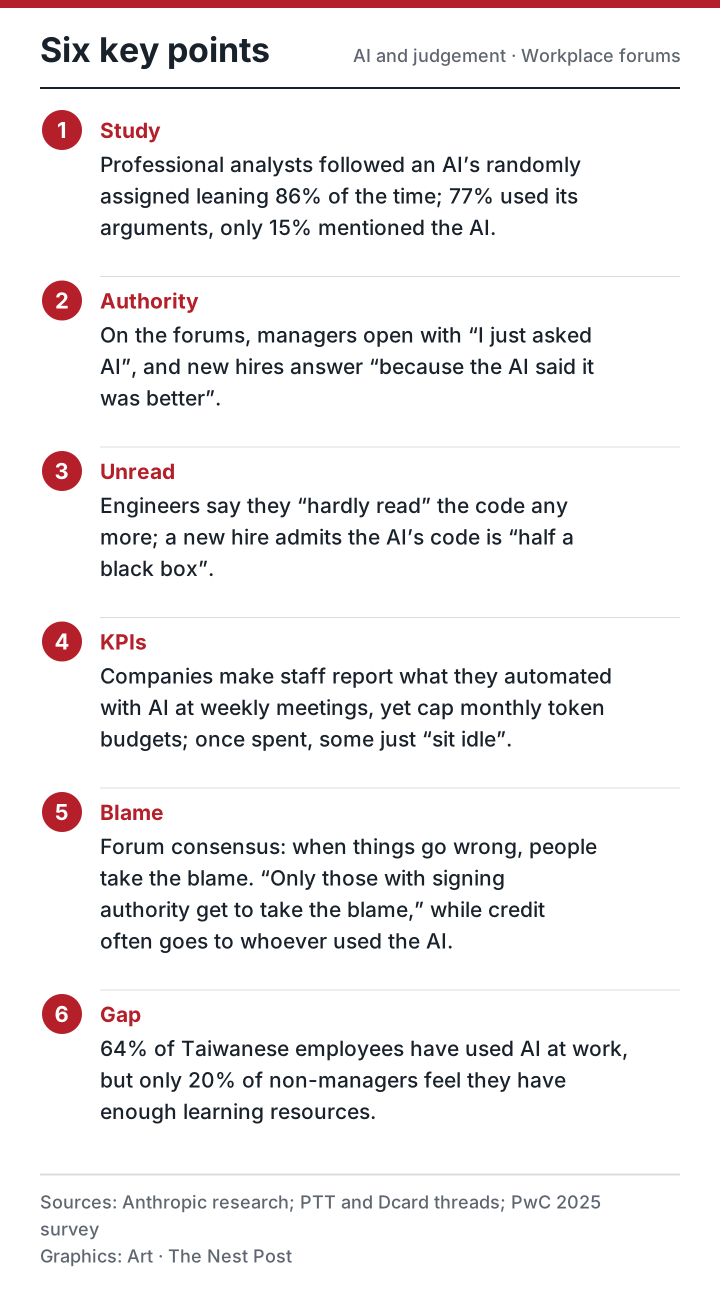
“I just asked AI…” At the end of June an office worker posted on Dcard’s work board to complain about a manager. Whether the poster asked a question, sought approval or was waiting for a decision, the manager’s first words were always the same. Even when a human expert had already been consulted, the manager would say: I asked AI too. The poster ended: “So is my manager the AI, or you?” In September an engineer who had spent nearly ten years at the chip-design company Silicon Motion described office conversations he had witnessed on Dcard’s tech-industry board. A manager asks an engineer why something was designed that way; the engineer answers: “Because the AI said this way is better.” Asked for details, the answer is: “Don’t know, I’ll go back and ask the AI.” The post drew 830 hearts and more than 400,000 views. These complaints line up with a new study. On 27 October the AI company Anthropic published the results of an experiment: 50 professional analysts did an analysis with an AI agent, and each one’s AI had been secretly set, by coin toss, to lean towards one option or another. The analysts followed the AI’s leaning 86% of the time; when they explained their reasoning afterwards, 77% used the AI’s arguments and only 15% mentioned that the arguments came from the AI. We read 39 threads and 17 posts from this year on PTT and Dcard about using AI at work, and compared them with research and surveys from Taiwan and abroad. Taiwanese office workers are not only asking whether AI will take their jobs, but about something more everyday: who is making the judgements, who is failing to learn, and who takes the blame when things go wrong.
In this story
- An experiment: 86% of the time, experts followed the AI
- “Let me go back and ask the AI”: AI becomes the office authority
- Not reading the code: a black box in exchange for speed
- The company wants you to use it: KPIs, dashboards and running out of tokens
- Who takes the blame: “You can carry the can; AI can’t”
- New hires who can’t learn, or who are never hired
- The other side: AI is more reliable than people; the problem is people
- “Have you AI’d it yet?”
An experiment: 86% of the time, experts followed the AI
First, how the experiment worked. Anthropic recruited 61 professional analysts with experience in causal inference who routinely write Python or R. Fifty of them used an AI agent to complete a task: assessing whether a fictional agricultural cooperative should expand a support programme. Along the way there were four analysis decisions where both options were reasonable, such as whether to measure yield as harvest per hectare or as cost per unit. The researchers tossed a coin in advance to decide which side each analyst’s AI would favour, and told the AI to argue honestly and change its position in the face of evidence.
The analysts chose the option the AI favoured 86% of the time; by chance it would have been 50%. Among those who had already stated a preference, 60% changed their minds when the AI disagreed, against only 6% when it agreed. Those who followed the AI most closely were about as confident in their final recommendation as everyone else; afterwards, 52% said the final recommendation was mainly their own judgement.
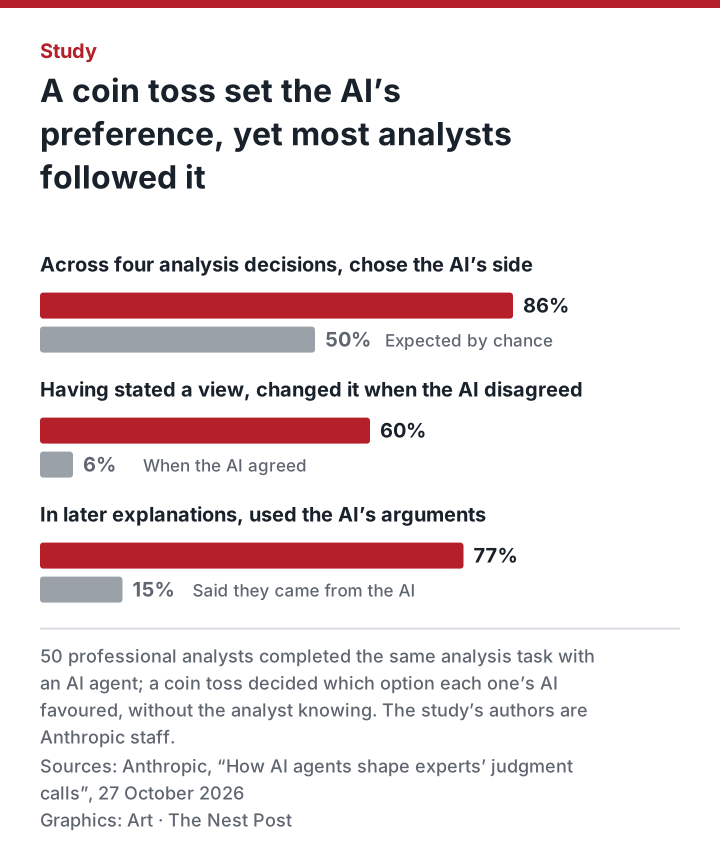
The researchers also set out the limits: the AI’s leanings were deliberately strengthened, and there was only one task in one profession. In the paper’s pre-registered analysis, the AI’s leaning had no significant effect on the “final recommendation”. Analysts who used the AI finished faster and made far fewer serious errors: 6 of the 11 who worked without AI made a mistake big enough to overturn their conclusion, against only 3 of the 50 who used it. This is not a story about AI being harmful; it is a story about judgement quietly changing hands. The study’s authors are Anthropic staff.
Other research points the same way. A 2025 survey of 319 knowledge workers by Microsoft Research and Carnegie Mellon University found that the more confidence people had in AI, the less critical thinking they did; the more confidence they had in themselves, the more they did. In a 2025 trial by METR, 16 experienced open-source developers took 19% longer when using AI, yet afterwards still believed it had made them 20% faster; METR now notes that this is an old result from early 2025.
“Let me go back and ask the AI”: AI becomes the office authority
On Taiwan’s forums, the most common scene is not “the AI got it wrong” but “the AI has the final say”. In the Silicon Motion engineer’s post, managers demand “ten things a day”, and the engineers’ answers all point to the AI.
RD:因為AI說這樣比較好
Engineer: Because the AI said this way is better.
最後大家的溝通方式就是 :你A了嗎?
In the end, the way everyone communicates has become: “Have you AI’d it yet?”
In October an engineer who said he worked on hardware simulation posted on Dcard’s tech-industry board under the title “New hires’ attitude now that there’s AI”. He said new hires throw waveform results at the AI without checking whether the logic is right. In the comments, one person said a colleague trusted the AI so much that he mixed up millimetres and mils; another put it more bluntly: checking itself has been sacrificed.
怎麼每個都說AI說的啊,
How come every one of them says “the AI said so”?
因為檢查正確性太花時間了,大家都為了效率跟產能而犧牲了檢查
Because checking whether it’s correct takes too much time, everyone has sacrificed checking for efficiency and output.
A thread on PTT’s Gossiping board, “Isn’t asking AI about everything dangerous?”, widened the scene from engineers to office workers in general. In the replies, someone said colleagues bring AI output straight into meetings without having read it themselves; others joked about managers’ position.
公司主管:不問ai,我會被問倒
Company manager: if I don’t ask the AI, I’ll be stumped.
帶過新人拿著AI回答跟我說:AI不可能錯
A new hire I trained held up the AI’s answer and told me: the AI can’t be wrong.
AnalysisSome think there is nothing new here. A Dcard comment said that it used to be “Stack Overflow says” and now it is “the AI says”; a PTT reply asked why people who are not afraid of other humans being wrong should worry about the AI being wrong. These rebuttals make a point: blind deference was not invented by AI. But the difference the experiment shows is that the AI volunteers opinions and argues fluently, and people often do not notice they are following it.
Not reading the code: a black box in exchange for speed
Software engineers were among the first, and the heaviest, users of AI. In May a post on PTT’s Soft_Job (software jobs) board, “In the AI era, do you still read code line by line?”, and the replies to it drew 337 comments between them, the biggest argument we read. The poster said reading code line by line was “very inefficient”.
我目前大部分都交給模型自己review 自己只看一些關鍵的地方
At the moment I leave most of it to the model to review itself, and only look at a few key places.
已經不太看了 每天要趕工那麼多東西 ai看出錯再說
I barely read it any more. I have so much to rush out every day; if something’s wrong, the AI can spot it.
The efficiency is real. In June someone on the same board shared that AI ran his tests and looked things up for him, so work that would have taken two weeks was done in two hours; in a reply thread about working with colleagues who can only use AI, one person said they had not written a single line of code for what they had built.
The costs are starting to show. On Dcard, a new hire fresh from a master’s degree admitted that all the code for their thesis had been written by AI, and that at work they hand bugs and new requirements to AI too.
現在連他產的扣對我而言也是半個黑盒子
Now even the code the AI produces is half a black box to me.
接了新案子後發現依賴AI造成對於code的理解能力大降
After I took on a new project I found that relying on AI had badly damaged my ability to understand code.
In another Anthropic experiment in January this year, 52 mostly junior engineers learned a new code library. The group that used AI averaged 50 points on a comprehension test afterwards; the group that coded by hand averaged 67, and the gap was largest on debugging questions. The researchers warn that under time and organisational pressure junior engineers may trade learning for speed, and what they lose is precisely the ability to work out why something has gone wrong.
The company wants you to use it: KPIs, dashboards and running out of tokens
Another experience shared across the forums is that using AI is no longer a personal choice. A post on PTT’s Salary board, “Will the company’s AI push end up replacing it?”, describes a company that requires everyone to produce work with AI; at the weekly meeting staff take turns reporting “which workflows I recently automated with AI”, and even handovers consist of nothing but a configured AI Skill.
News that Tesla was reportedly ranking employees by token usage drew first-hand accounts from Taiwanese employees on PTT’s Tech_Job (tech-industry jobs) board: one said the company required AI use but made staff buy their own accounts; another said a company subscription comes with a dashboard, and with it KPIs and lay-offs. A Dcard comment said its company’s performance indicators include AI usage, and that if you don’t use AI the boss will come down on you; this is a single anonymous account that we could not verify.
Usage has limits too. The Silicon Motion engineer wrote that his company caps tokens at US$65 per person per month, and once that is used up, some people just sit idle. In August someone on PTT’s Soft_Job board relayed how a newly hired architect used up the whole month’s allowance in two prompts; when the manager asked the boss for money to buy more, the boss was furious and told everyone to sort it out themselves.
The pressure reaches beyond engineers. A financial adviser on Dcard’s finance board said her bank required all financial-planning meetings to be recorded with AI. Her first client waved it away, “no, no”, afraid of leaving a record, so she took notes by hand for 40 minutes, and her manager’s response was that she should work on her communication skills. On the last day of October someone on the Gossiping board asked:
感覺工作因為AI都開始被期望24/7的方向了
It feels like, because of AI, work is starting to be expected to run 24/7.
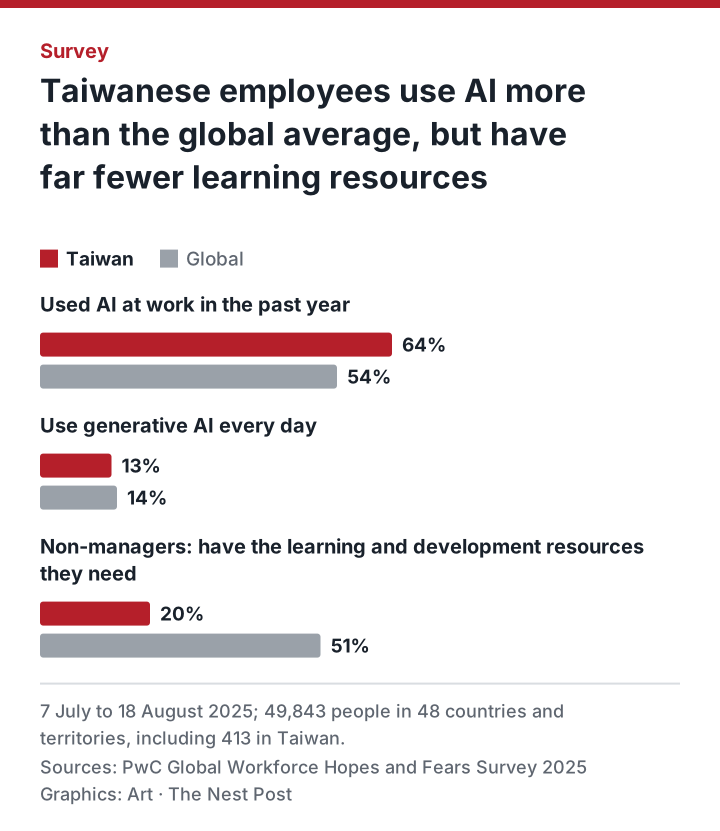
Taiwanese surveys reflect this gap between being required to use AI and being taught how. In PwC’s 2025 global workforce survey, 64% of Taiwanese respondents had used AI at work in the past year, above the global 54%, but only 13% used generative AI every day; among non-managers, only 20% felt they had the learning resources they needed, against 51% globally. A survey by the Institute for Information Industry (III) found that among people’s top three worries about generative AI, “over-reliance” was cited by 60%.
Who takes the blame: “You can carry the can; AI can’t”
If judgement is handed to AI, what about responsibility? The forums answer almost with one voice: it still falls on people. In the line-by-line code argument, two replies put it plainly.
反正出包 上面責任歸屬也丟給RD 不是AI
Anyway, when something blows up, the people above still pin it on the engineer, not the AI.
目前觀察,那些說不用看的,都不是負責正式環境的人
From what I’ve seen so far, the people who say you don’t need to read it are never the ones responsible for production.
A reply post on the Salary board presented this as a survival strategy, and someone immediately pushed back:
隨便舉個例,你能背鍋,AI不能,那你就不會被取代。
To give a random example: you can take the blame and the AI can’t, so you won’t be replaced.
想多了,有簽字權才有揹鍋權,你有嗎?
Dream on. Only those with signing authority get to take the blame. Do you have it?
A first-year engineer on Dcard said her colleagues let AI do the implementation and report directions they “worked out in discussion with the AI” at progress meetings; she learned the basics first and was instead judged to “learn poorly and work too slowly”. One commenter identified the real problem.
我覺得主要蠻困擾的地方是,責任歸屬變得很模糊。
I think what’s really troubling is that it has become very unclear who is responsible.
A high-level meeting described by an engineer on Dcard’s work board was more extreme: managers wanted an “AI brain” that could answer customers, process orders and make decisions on its own, with the goal of cutting half the staff. He wrote that data governance, access planning and who would be responsible when things went wrong were never mentioned. Another post described where the credit flows: code another department had cobbled together with AI was handed to him to redo, and after all that hard work, most of the credit went to them.
AnalysisPut the forums and the experiment side by side and an asymmetry appears: when things go right, the credit goes to the AI and to those who know how to use it; when they go wrong, the responsibility lands on the engineer who signed off. And in the experiment 77% used the AI’s arguments but only 15% said so, which suggests that even the people involved may not be able to tell which part of the judgement was their own.
New hires who can’t learn, or who are never hired
Junior employees face the hardest dilemma. A first-time manager asked on Dcard’s work board: a new hire builds features quickly with AI but cannot explain the logic; should he pass his probation? The 144 comments split into two camps, and one comment with 156 likes took the new hire’s side.
新人觀念才是對的,不善用工具者必定淘汰。
The new hire has the right idea. People who don’t make good use of tools are bound to be weeded out.
交出去的作業是我們人要負責,不要到時候出事了就推給ai。
We humans are responsible for the work we hand in. Don’t blame the AI when something goes wrong.
Some comments said nobody is willing to spend a year training new hires any more, and without fast output from AI you won’t even get through probation. Another company does the opposite and bans AI during probation so that new hires do not become over-reliant on it; one commenter asked whether using it every day after probation is not reliance too.
The bigger problem may be that new hires are not being hired at all. A study by Stanford University’s Digital Economy Lab, updated in August this year, found that in the occupations most exposed to AI, employment of 22- to 25-year-olds was 19% below the trend in less affected occupations, mainly because companies were hiring fewer young people rather than laying people off; experienced workers showed no similar gap. In a survey this year by the 1111 Job Bank and the Institute for Information Industry, only 11% of new graduates felt what they had learned at school fully met the needs of the workplace.
AnalysisOlder employees argue from the other end. One reply on PTT’s Tech_Job board argued that precisely because coding can be left to AI, experienced people become more valuable, since not everyone can judge and review. This sits somewhat uneasily with the experiment’s findings: the researchers examined ten characteristics, including years of experience, level of expertise and trust in AI, and none reliably predicted who would follow the AI.
The other side: AI is more reliable than people; the problem is people
Not everyone is worried. Plenty of replies argued that AI code review catches more problems than humans do; others said that in fields where you first have to work things out on a whiteboard, AI’s training data contains only the code, not the whiteboard, so people remain indispensable. Anthropic’s experiment also showed that those using AI made fewer serious errors.
AnalysisWhat really unsettles the forums may not be whether AI gets things wrong, but what is left for people when it gets them right. In June PTT’s Salary board reposted a Japanese news story: a 52-year-old office worker quit his job to change careers on ChatGPT’s advice, and found work only after more than three months unemployed, with his annual income falling from about ¥5 million to about ¥3 million. He said afterwards that the AI had not been wrong, but that he had “firmly believed its judgement must be correct”.
“Have you AI’d it yet?”
Back to the Silicon Motion engineer’s post. He wrote that work had not become easier since AI arrived: management’s expectations had gone from three things a day to ten, and colleagues’ greeting had become “Have you AI’d it yet?” Beneath it, a new hire commented that without heavy use of AI there was no way to get the work done, but the time to explore and learn had been wiped out too.
The Dcard post complaining about the manager who said “I just asked AI” argued that AI should be there to assist, not to replace your brain. The experiment’s researchers put it more cautiously: for human review to count as an independent check, the reviewer’s judgement has to be their own.
Subscribe to the newsletter from The Nest Post
One email each time an in-depth story is published, with the key points and any corrections. No advertising; unsubscribe at any time.