Local elections / Analysis
Taipei mayoral debate 2026
Taipei’s mayoral debate, sentence by sentence: half of it was attack and defence; Chiang talked about what he has done, Shen about what he would do
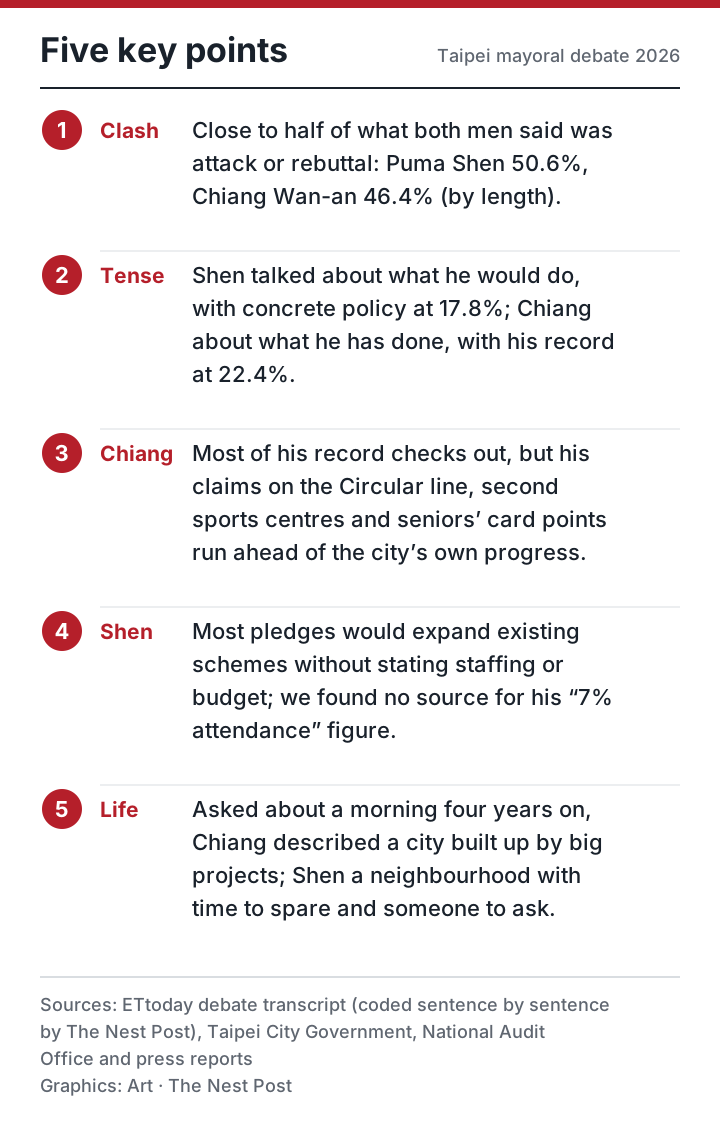
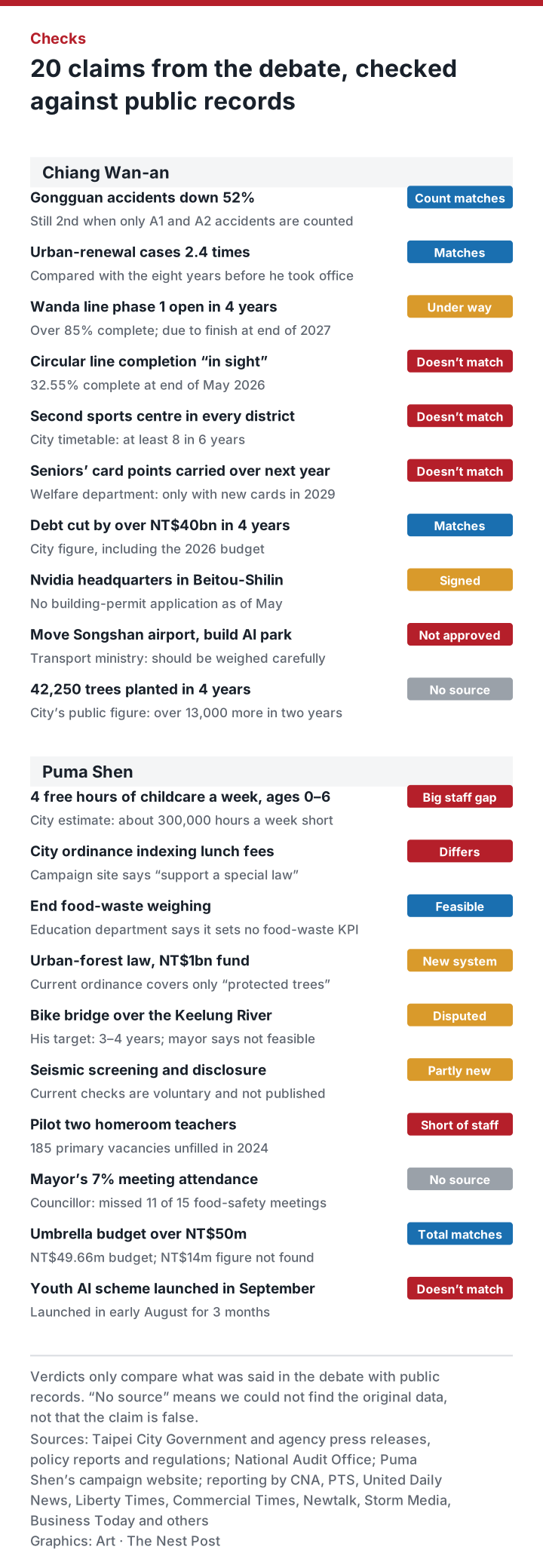
At noon on 31 October, Taipei’s mayor Chiang Wan-an of the Kuomintang and his challenger Puma Shen of the Democratic Progressive Party met in a TVBS studio for the only confirmed televised debate of the race. Over two hours they spoke about 24,000 Chinese characters between them. We split the transcript compiled by ETtoday into 711 sentences, coded each one, and checked 20 claims and figures the two cited against public records from the city government, the National Audit Office and the press. Both spent close to half their words attacking the other or defending themselves: Shen 50.6%, Chiang 46.4%. With the rest, Shen talked more about what he would do, with concrete policy taking 17.8% of his words; Chiang talked more about what he had done, with his record taking 22.4%. Most of their figures can be traced to a source, but both described some things as further along than they are, or cited numbers we could not find. And asked what a Taipei morning would look like four years from now, the two sketched two different ways of living in the city.
In this story
- Two hours, half of it attack and defence
- The Gongguan roundabout: each man half right
- Chiang’s “said it, did it”: mostly backed up, with a few claims running ahead of schedule
- Shen’s “you say it, I do it”: most pledges would expand existing schemes
- Accusations traded with numbers, some with no source
- Choosing a mayor, choosing a way of life
Two hours, half of it attack and defence
The debate, co-hosted by TVBS and SET, ran in four stages: eight-minute opening statements, three rounds of cross-examination, two questions from journalists, and closing statements. According to the transcript, leaving out greetings and transitions, Shen spoke about 12,501 Chinese characters and Chiang about 11,081.
We sorted every sentence by what it did into six categories: concrete policy (something still to be done, with a method or a number), record (something already done), attacking or questioning the opponent, rebuttal or clarification, emotional and value appeals, and personal stories. Shares are weighted by length (sentence-by-sentence results). For both men, confrontation took the largest share: Shen spent 28.4% of his words attacking and 22.2% rebutting; Chiang 34.2% attacking and 12.2% rebutting. The difference is that Shen put more effort into defending policies of his that had been challenged, while Chiang spent more time questioning things his opponent had said in the past.
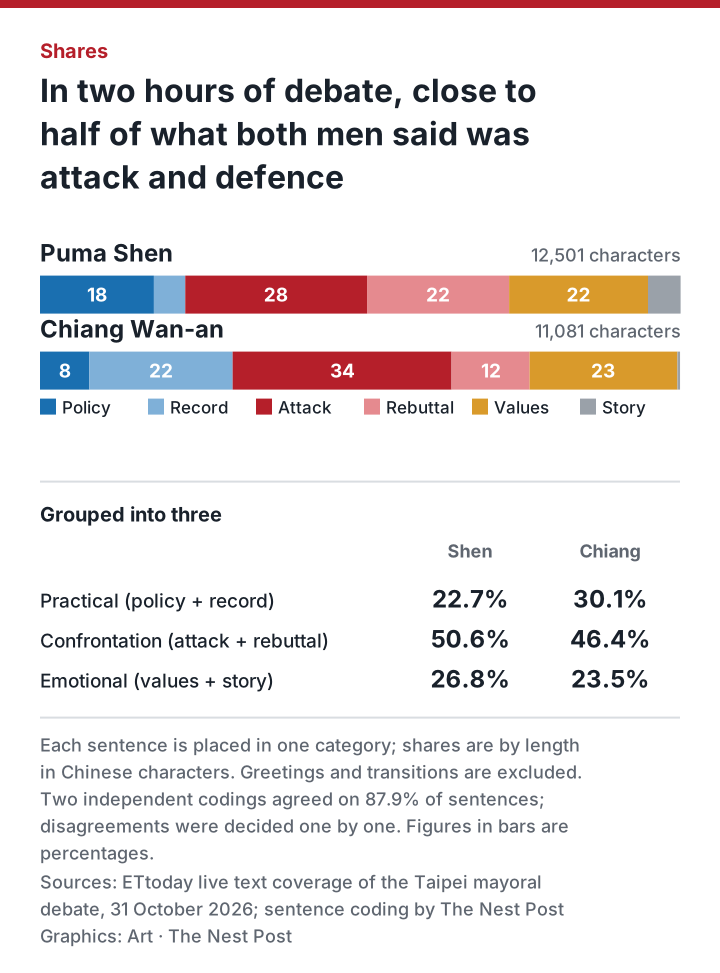
On the practical side, the two went in opposite directions. Shen, the challenger, spent 17.8% of his words on concrete policy and only 4.9% on any record; Chiang, the incumbent, spent 22.4% on his record and only 7.7% on future policy. Their opening statements set the tone.
4年前我說到,4年後我做到
Four years ago I said it; four years on, I have done it.
之前蔣市長有提到,他對於台北市政未來的4個字叫開創未來,而我叫做你說我做。
Mayor Chiang has said his four words for the city’s future are “pioneering the future”. Mine are “you say it, I do it”.
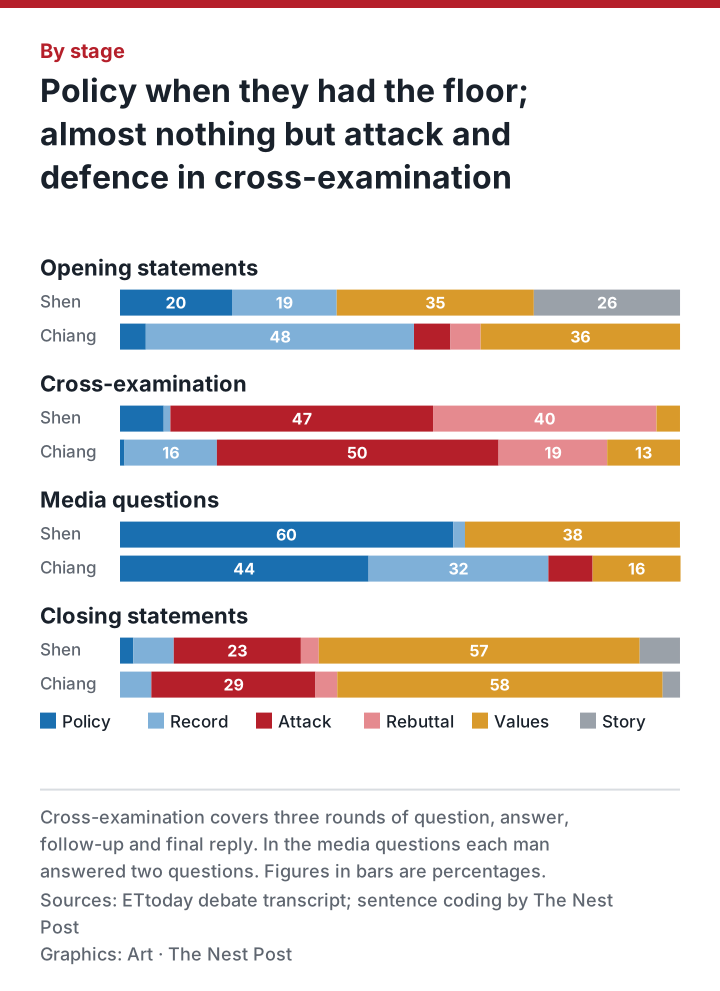
Broken down by stage, the difference is sharper. The opening statements and the media questions were time each man controlled, and policy and record took their largest shares there. In cross-examination nearly everything was attack and defence: 87% of Shen’s words and 69% of Chiang’s. The most common complaint on both sides was that the other had not answered the question.
沈委員,你還真的是不了解市政,非常不熟悉,已讀亂回。
Legislator Shen, you really don’t understand city affairs. You are very unfamiliar with them: you read the question and answer something else.
因為我剛剛是在問你這些會議為什麼不出席,結果你剛剛回答的是我即刻會馬上出席,這沒有回答問題啊。
I just asked you why you didn’t attend these meetings, and your answer was that you would attend right away. That doesn’t answer the question.
The Gongguan roundabout: each man half right
The most direct clash of numbers was over the Gongguan roundabout, a large traffic circle next to National Taiwan University that the city removed in 2025. Chiang said in his opening statement that the accident rate had fallen 52% since it was removed. Shen hit back in cross-examination:
但是我要告訴你,就今天早上而已,他又重回了事故的第1名,而且他附近的這一個路口,甚至本來在10名之外,結果也擠進了前10名。
But let me tell you, as of this very morning it is back at number one for accidents. And a nearby intersection that used to be outside the top ten has squeezed into the top ten as well.
In his last answer Chiang said Shen was “using false data”, and insisted the count be done differently:
我們在計算整個交通事故。是要A1、A2、A3一起來討論。
We count all traffic accidents. A1, A2 and A3 have to be considered together.
A 13 October press release from the city’s Traffic Engineering Office explains both claims. In the year after the redesigned junction opened (29 September 2025 to 30 September 2026) there were 128 accidents, a monthly average of 10.67, 52.30% fewer than the average of 22.36 a month in the three years before. That is Chiang’s figure. But the same release says that counting only A1 and A2 accidents, those involving deaths or injuries, the junction ranks second among the city’s accident hotspots; it falls to tenth only when A3 accidents, which cause damage alone, are included.
On the day of the debate the city’s Department of Transportation told reporters that Shen was probably citing the ranking on the transport ministry’s road-safety website, which uses the CBI indicator and includes only A1 and A2 accidents. On CBI, Gongguan does rank first; by number of accidents it ranks second. In other words, total accidents did halve, but the junction still ranks near the top for accidents with casualties. Demolition was scheduled to take 65 days and took 17; neither man disputed that.
Chiang’s “said it, did it”: mostly backed up, with a few claims running ahead of schedule
In his opening statement Chiang listed a long run of achievements: the Taipei Dome, Nvidia’s move to the Beitou-Shilin Science Park, doubled birth subsidies, a free first 30 minutes on YouBike, the Double Ninth bonus for seniors, a new Youth Department and the opening of the Diding Boulevard ramp. Most of these are in place and can be checked. What needs a closer look is how he described the next four years, and the figures he cited in the debate.
Urban renewal. Chiang said Taipei had 2.4 times as many urban-renewal cases in his four years as before. The city’s press release puts it as 2.4 times the number filed in the eight years before he took office: a comparison with the city’s own past, not with other cities. He also said the figure was “1.3 times the other five special municipalities combined”, then 1.4 times during the media questions; we found no source for that comparison. His example of “Kangle Street, the first 7599 project” is also off. The city’s own release says Lane 136 of Kangle Street in Neihu was the first signed case of the “575 project” under its “eight arrows” renewal programme; the first signed 7599 case was Lane 60 of Hulin Street in Xinyi, in August.
Metro. He said that four years from now “phase one of the Wanda MRT line will be open”, which matches progress: phase one was more than 85% complete in August and is due to be finished at the end of 2027. But he went on:
捷運南環北環段的完工也就在眼前。
Completion of the southern and northern sections of the Circular line is in sight.
The policy report the city sent to the council says the northern and southern sections of the Circular line were 32.55% complete at the end of May 2026, and the eastern section 15.00%. Calling completion “in sight” at a little over 30% does not match the city’s own numbers.
Sports centres and the seniors’ card. Chiang said that in four years “every district will have its second sports centre”. When the city opened the first second centre, in Xinsheng, in July, Chiang himself said “at least eight will be finished in six years”; Taipei has 12 districts. On the seniors’ card, he said that from next year it could be used at supermarkets, convenience stores, farmers’ associations and pharmacies, and that “you don’t have to worry about unused points; they can be carried over”. A June press release from the Department of Social Welfare says pharmacies, convenience stores, supermarkets and farmers’ associations will be added in the second half of 2027, but carrying points over will only start when second-generation cards are issued in 2029.
Finances and childcare. Cutting debt by more than NT$40 billion in four years is the city’s own figure: outstanding debt, NT$89.8 billion when he took office, is expected to fall to NT$46.8 billion. NT$27.4 billion was repaid in 2023–2025, and the rest comes from this year’s budget and additional repayments. On childcare, he said that “in four years every school will have public childcare”. The city’s 92 public infant-care centres now have 2,008 places, and a councillor said 3,854 children were on the waiting list; this year the city identified 16 sites on school campuses and in public buildings, expected to add 620 places.
Nvidia and Songshan airport. Nvidia signed for its Beitou-Shilin headquarters in February, and the city says construction and operation will create about 10,000 jobs, but by May no building-permit application had been filed. Chiang’s biggest new pledge in this race is to move Songshan airport and build a Taipei AI park on the site, which the city estimates could generate NT$12 trillion in output. In the debate Shen argued that this counted the turnover of the Neihu Technology Park as output; neither side has published its calculation. The central government’s position is clear. The transport ministry says that without concrete supporting measures the idea should be weighed carefully from a national perspective, and the Executive Yuan’s spokesperson said the city had not submitted a relocation plan in four years; Chiang produced an official letter dated 8 August 2023 and said the city had long made its position known.
Trees. Chiang said the city had planted 42,250 trees in four years. We found no source for that figure; in a September interview he said the number of trees had risen by more than 13,000 over two years. Some claims do check out: by the end of June 480 companies had joined the city’s scheme letting parents cut working hours without a pay cut, as he said.
Shen’s “you say it, I do it”: most pledges would expand existing schemes
Most of Shen’s pledges have not been tried, so two things can be checked: what his campaign website says, and whether Taipei already has something similar and the staff to run it.
Free drop-in childcare. In cross-examination Chiang argued that Shen’s pledge of four free hours of drop-in childcare a week for children up to six could not be delivered:
我幫你算過了,就算全台北市有執照的保母都投入,還要再4倍的人力。你知道你在說什麼嗎?
I have done the maths for you. Even if every licensed nanny in Taipei took part, you would need four times as many people. Do you know what you are saying?
我們要先從0到2開始做,而且我們要先場所的擴大,然後一直到人員的培訓,然後再進入到人力的補充,這是階段式的來做。
We will start with ages zero to two. First we expand the venues, then we train staff, then we add personnel. It is done in stages.
Shen’s campaign website promises children from six months to six years “a fixed number of free drop-in childcare hours each week”, with no hours, budget or staffing, and nothing about starting with under-twos. Taipei now has 23 drop-in childcare sites, and the city already offers an eight-hour free childcare voucher. The Department of Social Welfare estimated in June that four hours a week would require about 410,000 hours of care a week, against nearly 130,000 available now: a gap of about 300,000 hours. A Kuomintang estimate puts the number of registered nannies in Taipei at about 4,200, of whom about 2,000 actually work. Staffing is the pledge’s biggest problem.
School lunches. In his opening statement Shen said that once elected he would ask the city council to pass “Taipei’s own ordinance” so that lunch fees track prices, and would end the weighing of food waste. His campaign website instead says he supports a special law with a fee-adjustment mechanism, which would be passed by the national legislature rather than the city; that differs from what he said in the debate. On food waste, the Department of Education said in September that it sets no food-waste KPI and that lunch contractors generally help with the weighing. Ending it would not be hard, but there is no public data on how much of a burden it places on schools.
Trees and an urban forest. Shen’s “bring the trees back” pledge, his website says, means dedicated staff, a dedicated law, dedicated funding and expertise: an urban-forest ordinance and a fund of NT$1 billion. Taipei’s current tree-protection ordinance covers only protected trees that have been formally designated, with no rules on ordinary street trees or canopy, so this would be a new system built from scratch.
A bike bridge and earthquake safety. Shen wants to build a cycle-only bridge across the Keelung River between Yingfeng and Gangqian, linking the Minsheng Community with the Neihu Technology Park, and says it would take three to four years. Chiang said in the debate that the bridge would cost NT$950 million; that figure in fact came from Shen’s own policy launch. In September Chiang said the city had studied the idea two years earlier and found it technically unfeasible. On earthquake safety, Shen wants the city to run preliminary seismic screening of buildings itself, send teams to people’s homes and then publish the results. Chiang said the city was “already doing it”. Existing checks on old buildings are indeed subsidised, for example NT$6,000 per building for an initial assessment, but residents must apply themselves, and the rules say the results may not be disclosed at will. City-led screening with public results would differ from the current system.
Two homeroom teachers. Shen said a scheme giving primary-school classes two homeroom teachers would be piloted first, and his website says the same, without a budget or timetable. Teacher shortages are a real problem in Taipei: of 461 primary-school vacancies the city advertised in 2024, 185 went unfilled.
Accusations traded with numbers, some with no source
In cross-examination both men brought out figures from the other’s past. Shen said Chiang had attended only 7% of drug-prevention meetings and 7% of child-welfare committee meetings, and none of 18 cross-department meetings on the smoke-free city policy. The sources we found are mostly councillors’ questions or tallies by members of the public, not official records. The smoke-free meetings were tallied on social media, and a report said “Chiang did not attend once”, with a deputy mayor in the chair. The drug-prevention meetings were likewise tallied by a member of the public, and Chiang said at the time it was not true. In July councillor Miao Poya said he had missed 11 of 15 meetings of the city’s food-safety committee. We did not find the “7%” figure in any report or record.
Shen said the budget for sun umbrellas had ballooned from NT$14 million to more than NT$50 million in the final three months. Reports confirm a construction budget of NT$49.66 million for eight umbrellas; we found nothing on the NT$14 million figure or the timing. He also said the city’s youth AI scheme “went live in September and will stop in November”; in fact it launched in early August and runs for three months.
Shen said “as many as 96” pupils at Chengyuan Junior High School had fallen ill; reports put the number at 87 pupils with diarrhoea, with Staphylococcus aureus enterotoxin detected. His claim that tendering for free school lunches went badly before term began is backed by reports: in early August 60% of schools still had no contractor. For his part, Chiang said residents’ positive view of the smoke-free city policy was “close to 90%”. A survey by the city’s research and evaluation commission found 96.2% support for the same rules at large events and in crowded public places, which is not quite the same question.
Choosing a mayor, choosing a way of life
In the media questions, Fan Chi-ming of TVBS gave both men a concrete scenario: someone who lives in Taipei, works in the Neihu Technology Park or the Beitou-Shilin Science Park, takes a child to school and looks after an elderly relative at home.
這個台北市民從他每天早上出門的那一刻開始。四年之後的這一天,他的生活會出現什麼樣子的改變。
Start from the moment this Taipei resident leaves home in the morning. On that day four years from now, how will their life have changed?
Chiang’s answer was almost a list of projects: shorter working hours for parents, public childcare without a queue, driverless buses, the Wanda line open, second sports centres, new uses for the seniors’ card, the river “blue highway”, a music library, negative-pressure smoking rooms, fences going up around old buildings as work begins, and social housing from renewal projects to move into.
送完孩子,你搭著無人自駕公車上班,路過輝達的新總部,感受到北士科已經是世界級的AI示範場域。
After dropping off the kids, you take a driverless bus to work, pass Nvidia’s new headquarters, and feel that Beitou-Shilin is already a world-class AI showcase.
那整座城市都在翻新,大步地向前走的節奏,讓人隨處都能感受到台北的活力。
The whole city is being renewed, and the rhythm of striding forward lets you feel Taipei’s energy everywhere.
Shen’s answer started from another direction: first, give people their time back. He talked about a full review of the metro, bus routes and safe routes to school, then a single help desk for parents, fitness minibuses that come to neighbourhoods, a parent-and-child travel card, shopping districts and bookshops.
我覺得這個問題的關鍵應該是在於,我們要怎麼樣讓大家更悠閒的生活。
I think the key to this question is how we let everyone live a more relaxed life.
可以在家裡附近,可能這個書店就辦了一個走讀的活動,他可以參加,書店賺到錢,父母也稍微放鬆一下,小孩可以學到東西。
Near home, maybe a bookshop runs a walking tour that they can join. The bookshop makes money, the parents get to relax a little, and the kids learn something.
AnalysisPut their answers and closing statements side by side and two Taipeis emerge. Chiang’s is a city “striding forward”: life changes through big projects and industry, from the AI headquarters to the metro, urban renewal and sports halls. The city government’s job is to build them, and residents live amid the convenience they bring. In his closing statement he said residents want “someone who can make complicated things simple”.
我相信台北市民要的,不是一個能把簡單的事說得複雜的人,而是要能把複雜的事變得簡單的人。
I believe what Taipei residents want is not someone who makes simple things sound complicated, but someone who can make complicated things simple.
AnalysisShen’s is a city that is a little slower, where someone is there to catch you: life changes through time, company and neighbourhood, from routes to school to a parenting hotline, community fitness and walking tours of shopping streets. The government’s job is to make sure people “can find the mayor”. In his closing statement he said numbers are like the reading on a thermometer, “not the temperature we actually feel”, and ended by quoting something a cultural figure had said on a television programme.
他說,不用管哪個候選人贏,你要管你有沒有贏。當你把票投給你想要的生活方式的時候,你就贏了。
He said: don’t worry about which candidate wins; worry about whether you win. When you vote for the way of life you want, you have won.
AnalysisEach picture leaves questions the debate did not answer. Several items on Chiang’s list are further behind than he said, and moving Songshan airport does not have the central government’s approval. Most of Shen’s care-centred pledges come without a stated budget or staffing, and the city puts the drop-in childcare gap at 300,000 hours. On 28 November voters will be choosing both a picture of daily life and the person more likely to deliver it.
Subscribe to the newsletter from The Nest Post
One email each time an in-depth story is published, with the key points and any corrections. No advertising; unsubscribe at any time.